
Single Axle vs Tandem Axle Enclosed Trailers: How to Choose the Right Setup for Your Cargo, Business, and Towing Needs
Choosing the right enclosed trailer is not only about size, color, price, or door style. One of the most important decisions a buyer can make is whether to choose a single axle or tandem axle enclosed trailer.
The axle setup affects how much weight the trailer can support, how it feels behind the tow vehicle, how stable it is on longer trips, how much maintenance it may require, and how useful the trailer will be as your needs grow. For buyers comparing enclosed cargo trailers for motorcycles, tools, landscaping equipment, construction materials, mobile business setups, or general hauling, understanding the difference between single axle and tandem axle trailers can prevent an expensive mistake.
Make My Trailer, a factory-direct enclosed trailer provider based in Douglas, Georgia, encourages buyers to think about axle configuration early in the shopping process. A trailer that works well for occasional light hauling may not be the best fit for a contractor hauling heavier tools every day. On the other hand, a buyer who only needs a compact trailer for household items, one motorcycle, or weekend projects may not need the added weight, cost, and maintenance of a tandem axle model.
This guide explains how single axle and tandem axle enclosed trailers compare, what each setup is best for, and what questions buyers should ask before ordering.
- What Is a Single Axle Enclosed Trailer?
- What Is a Tandem Axle Enclosed Trailer?
- Single Axle vs Tandem Axle: The Main Difference
- Which Is Easier to Tow?
- Which Is Better for Light Hauling?
- Which Is Better for Motorcycles?
- Which Is Better for Tools and Contractors?
- Which Is Better for Landscaping?
- Which Is Better for Heavier Equipment?
- Which Is Better for Long-Distance Travel?
- Does Tandem Axle Mean Better Stability?
- How Axle Setup Affects Braking
- How Axle Setup Affects Maintenance
- How Axle Setup Affects Cost
- How Axle Setup Affects Resale Value
- Is a 6x12 Better as Single Axle or Tandem Axle?
- Questions to Ask Before Choosing
- Single Axle Enclosed Trailer: Best-Fit Summary
- Tandem Axle Enclosed Trailer: Best-Fit Summary
- Final Recommendation
- Frequently Asked Questions
What Is a Single Axle Enclosed Trailer?
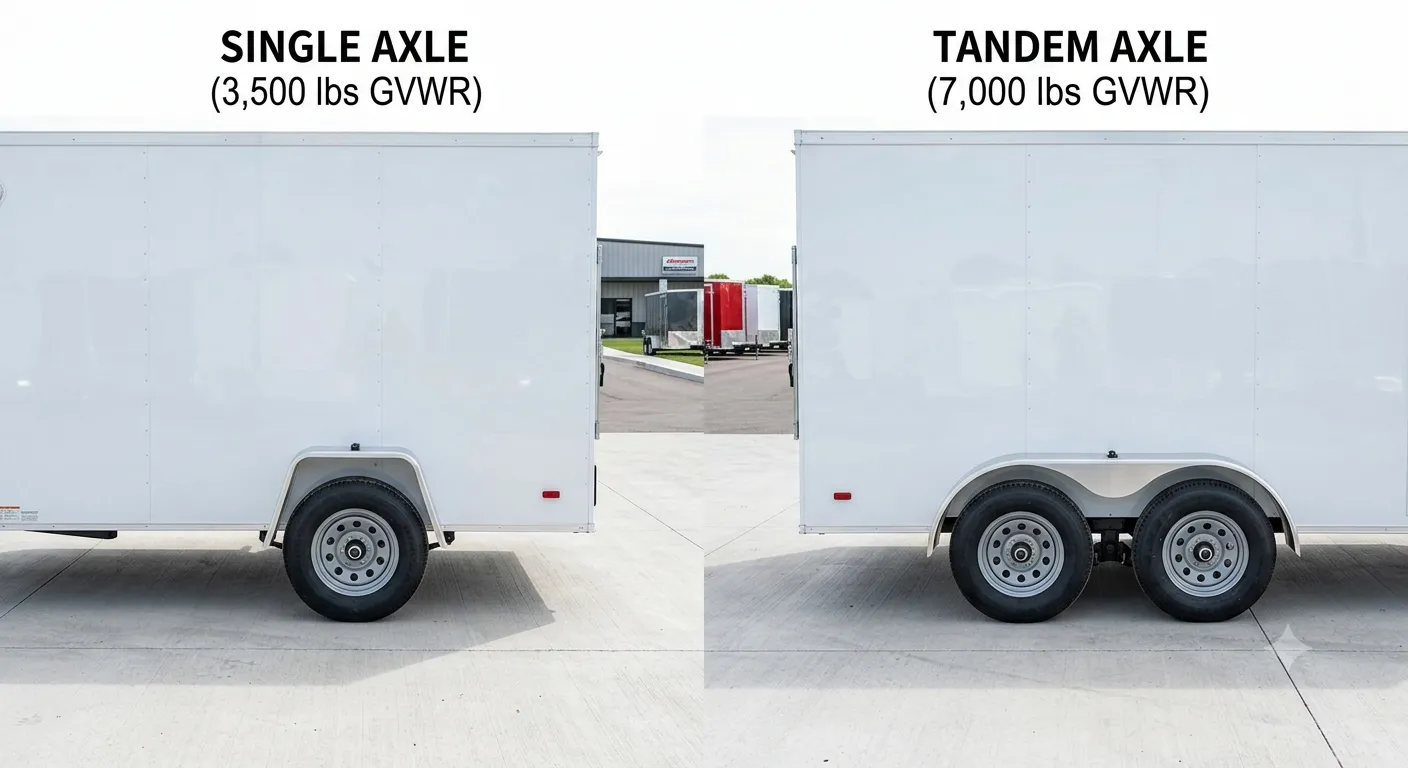
A single axle enclosed trailer has one axle and two wheels. This setup is common on smaller enclosed cargo trailers, including many 5x8, 6x10, 6x12, and some 7-foot-wide models designed for lighter or moderate hauling.
Single axle enclosed trailers are popular because they are simple, lighter, easier to move around, and usually more affordable than tandem axle models. For buyers who do not need maximum payload capacity, a single axle trailer can be a practical and cost-effective choice.
Common uses for single axle enclosed trailers include:
A single axle trailer can be especially useful for buyers who value maneuverability. It is easier to back into tight spaces, easier to park in a driveway, and often easier for first-time trailer owners to handle. Because there are fewer tires, hubs, bearings, brakes, and suspension components, maintenance can also be simpler.
However, a single axle trailer is not the best option for every buyer. It has less load support than a properly rated tandem axle trailer and may not provide the same level of stability when hauling heavier cargo at highway speeds. Buyers should always compare the trailer’s GVWR, empty weight, payload capacity, axle rating, tire rating, and tow vehicle capacity before choosing a single axle setup.

What Is a Tandem Axle Enclosed Trailer?
A tandem axle enclosed trailer has two axles and four wheels. This setup is common on larger trailers and on trailers built for heavier, more frequent, or more commercial hauling.
Tandem axle trailers are often chosen by contractors, landscapers, equipment haulers, motorsports users, and small business owners because they can offer more support, better weight distribution, and greater towing confidence when properly loaded and matched to the correct tow vehicle.
Common uses for tandem axle enclosed trailers include:
A tandem axle trailer may cost more upfront, but it can be a better long-term fit for buyers who expect their cargo needs to grow. If a business owner starts with a light setup but later adds shelving, racks, toolboxes, compressors, water tanks, or heavier machinery, a tandem axle configuration may provide more room for growth.
Tandem axle trailers are also commonly preferred for longer trips because the extra axle can improve stability and ride quality, especially when the trailer is loaded properly. For buyers who plan to travel often, haul at highway speeds, or carry cargo over longer distances, that added confidence can matter.
Single Axle vs Tandem Axle: The Main Difference
The biggest difference is load support.
A single axle trailer supports the trailer and cargo on one axle. A tandem axle trailer spreads the weight across two axles. That does not mean buyers should assume a tandem axle trailer automatically carries “double” the weight. Capacity depends on the trailer’s actual GVWR, axle ratings, tires, frame, suspension, brakes, and manufacturer specifications.
The right question is not simply, “Does it have one axle or two?”
The better question is: “What is the total rated capacity of this trailer, and does that match the cargo I plan to haul?”
A trailer buyer should look at:
Payload capacity is especially important. Payload is the weight the trailer can safely carry after subtracting the trailer’s empty weight from its GVWR. A trailer may look large enough physically, but if the cargo exceeds the rated payload, it is not the right trailer.
Which Is Easier to Tow?
For light loads and local driving, a single axle enclosed trailer is often easier to tow because it is lighter. A lighter trailer places less demand on the tow vehicle, may be easier to maneuver, and can be simpler to park.
Single axle trailers are often a good fit for:
Tandem axle trailers may feel more stable when loaded, especially at highway speeds, but they are usually heavier and may require a more capable tow vehicle. They also take more space to turn and park. A tandem axle trailer can be a better towing experience when carrying heavier loads, but it is not automatically easier for every driver.
The tow vehicle matters just as much as the trailer. A properly rated pickup may handle a tandem axle enclosed trailer well, while a smaller SUV may be better matched to a lighter single axle model. Buyers should check the vehicle owner’s manual, hitch rating, brake controller requirements, and trailer weight ratings before finalizing a purchase.
Which Is Better for Light Hauling?
For light hauling, a single axle enclosed trailer is usually the practical choice.
Examples of light hauling include:
A single axle trailer keeps the setup simple. The buyer gets enclosed cargo protection without paying for capacity they may not use. It is also easier to move by hand when empty, easier to store, and often less expensive to maintain.
That said, “light hauling” should still be measured. Buyers should estimate the actual weight of cargo instead of guessing. Tools, equipment, shelving, generators, fuel cans, and spare parts add up quickly. A trailer that feels like “light use” at first can become overloaded once it is packed.
Which Is Better for Motorcycles?
Both single axle and tandem axle enclosed trailers can work for motorcycles, depending on the number of bikes, the size of the motorcycles, tie-down setup, and travel distance.
A single axle enclosed trailer may work well for:
A tandem axle enclosed trailer may be better for:
Motorcycle buyers should also think about ramp doors, floor strength, D-rings, E-track, wheel chocks, tie-down angles, and interior height. A ramp door is usually more convenient for motorcycles because it allows the bike to roll in and out. Barn doors can work for boxed cargo but are usually less convenient for rolling equipment unless separate ramps are used.
Before buying, measure the motorcycle’s total length, width, handlebar clearance, and height. Also consider how much space is needed to walk around the bike and attach tie-down straps safely.

Which Is Better for Tools and Contractors?
For contractors, the right axle setup depends on how much equipment is carried and how often the trailer is used.
A single axle trailer may be enough for:
A tandem axle trailer is usually a better fit for:
Contractors often underestimate how fast weight increases after adding shelves, cabinets, racks, spare materials, and jobsite tools. A trailer may start as a simple cargo box and eventually become a mobile workshop. When that happens, a tandem axle trailer may provide better long-term flexibility.
For trades such as electrical, plumbing, HVAC, flooring, roofing, remodeling, and general contracting, buyers should think beyond today’s tool load. If the business is growing, the trailer should have enough capacity for future equipment.
Which Is Better for Landscaping?
Landscaping businesses often benefit from tandem axle enclosed trailers, especially when hauling commercial mowers and heavier equipment.
A single axle enclosed trailer may work for:
A tandem axle enclosed trailer may be better for:
Landscapers should consider more than floor length. They should think about ramp door strength, interior height, door opening width, ventilation, floor durability, tie-down placement, and organization. A trailer used for landscaping will often carry messy, heavy, and frequently loaded cargo, so long-term durability matters.
If the trailer will be used daily for business, the extra cost of a tandem axle setup may make sense because it can support more demanding use and may offer better resale value later.
Which Is Better for Heavier Equipment?
For heavier equipment, tandem axle is usually the safer and more practical choice, assuming the trailer is properly rated for the load.
Examples of heavier equipment include:
Tandem axle trailers are commonly chosen for heavier equipment because the load is spread across more tires and axles. This can improve stability, support higher GVWR ratings, and provide a better platform for frequent commercial use.
However, buyers should never assume that a tandem axle trailer can carry any heavy load. The rating plate and manufacturer specifications are what matter. A trailer should never be loaded beyond its GVWR, axle rating, tire rating, or hitch rating.

Which Is Better for Long-Distance Travel?
For longer-distance travel, tandem axle trailers often provide more confidence, especially when hauling moderate to heavy cargo.
Long-distance towing introduces factors that may not matter as much on a short local trip:
A single axle trailer can still be used for long trips if it is properly rated, properly loaded, and maintained. But for buyers who expect frequent highway travel, heavy cargo, or long-distance business routes, tandem axle is usually worth considering.
Before a long trip, trailer owners should inspect tires, tire pressure, lug nuts, lights, brakes, safety chains, coupler connection, breakaway system, wheel bearings, door latches, roof seams, and cargo securement.
Does Tandem Axle Mean Better Stability?
In many cases, yes. Tandem axle trailers often feel more stable than single axle trailers when hauling heavier loads, especially at highway speeds. The extra axle helps spread weight across more contact points and may reduce bounce compared with a heavily loaded single axle trailer.
But stability still depends on loading. A poorly loaded tandem axle trailer can still sway. A correctly loaded single axle trailer may tow very well within its limits.
Important stability factors include:
The safest trailer is not simply the one with more axles. It is the one properly matched to the tow vehicle, properly rated for the cargo, and properly loaded.
How Axle Setup Affects Braking
Braking is one of the most important reasons to pay attention to axle setup and trailer weight.
Heavier trailers often require trailer brakes, and many tandem axle enclosed trailers are equipped with electric brakes depending on the configuration and rating. Trailer brakes help reduce strain on the tow vehicle and improve stopping control when properly installed and adjusted.
Buyers should check state requirements and manufacturer specifications. In Georgia, trailers over a certain gross weight may require brakes, and commercial users may have additional obligations. Buyers who cross state lines should verify the laws in every state where they tow.
For business owners, braking should not be treated as an optional detail. A trailer that is used daily, loaded heavily, or towed through traffic should be set up with safe stopping performance in mind.
How Axle Setup Affects Maintenance
Single axle trailers usually have fewer wear components. That can mean lower maintenance costs over time.
A single axle trailer has:
A tandem axle trailer has:
This does not mean tandem axle trailers are unreliable. It simply means there are more parts to inspect and maintain. For commercial users, that additional maintenance may be worth it because the trailer provides more capability.
A proper maintenance plan should include:
How Axle Setup Affects Cost
Single axle trailers usually cost less upfront because they require fewer components and are generally lighter. This makes them attractive to first-time buyers and customers with limited hauling needs.
Tandem axle trailers usually cost more because they use additional axles, tires, suspension parts, brakes, and frame support. They may also cost more to maintain and may create higher toll costs in some areas due to the additional axle.
But the lowest purchase price is not always the best value.
A single axle trailer is a good value when it fits the buyer’s actual use. A tandem axle trailer is a better value when the buyer needs more capacity, longer-distance confidence, commercial durability, or stronger resale appeal.
The mistake is buying too little trailer to save money today, then needing to replace it later when cargo needs grow.
How Axle Setup Affects Resale Value
Tandem axle enclosed trailers may appeal to a broader range of future buyers because they are commonly associated with heavier-duty use, commercial applications, and more versatile hauling. Contractors, landscapers, powersports users, and business owners often shop for tandem axle trailers because they want additional capacity and stability.
That does not mean single axle trailers have poor resale value. Clean, well-maintained single axle enclosed trailers are still attractive to buyers who want lighter, easier-to-tow cargo protection.
Resale value depends on:
If resale value matters, buyers should consider choosing a trailer size and axle setup with broad appeal. For many buyers, a popular size such as a 6x12 enclosed trailer can be a strong resale candidate because it works for both personal and business use.
Is a 6x12 Better as Single Axle or Tandem Axle?
The 6x12 enclosed trailer is one of the most common sizes where buyers compare single axle vs tandem axle setups.
A 6x12 single axle enclosed trailer may be a good fit for:
A 6x12 tandem axle enclosed trailer may be a better fit for:
The best choice depends on the loaded weight, not just the floor size. A 6x12 trailer can physically fit many types of cargo, but the axle setup and payload rating determine how much it can safely carry.
Questions to Ask Before Choosing Single Axle or Tandem Axle
Before choosing an enclosed trailer, buyers should ask:
These questions help buyers avoid choosing based only on price. The right trailer is the one that matches real cargo, real towing conditions, and real future use.
Single Axle Enclosed Trailer: Best-Fit Summary
A single axle enclosed trailer is usually best for buyers who want:
Best use cases include household hauling, small tools, one motorcycle, light lawn equipment, weekend projects, small inventory, and buyers who do not expect heavy daily use.
Tandem Axle Enclosed Trailer: Best-Fit Summary
A tandem axle enclosed trailer is usually best for buyers who want:
Best use cases include contractors, landscapers, mobile service businesses, multiple motorcycles, heavier equipment, longer-distance travel, and buyers who expect their cargo needs to grow.
Final Recommendation
Choose a single axle enclosed trailer if your cargo is light, your trips are mostly local, your tow vehicle is smaller, and you want a simpler, more budget-conscious setup.
Choose a tandem axle enclosed trailer if your cargo is heavier, your trailer will be used frequently for business, you plan to travel longer distances, or you want more room to grow into future equipment and upgrades.
The most important step is to match the trailer to the job. That means checking the trailer’s GVWR, empty weight, payload capacity, axle rating, tire rating, brake setup, hitch rating, and tow vehicle capacity before ordering.
For buyers comparing enclosed trailer options, Make My Trailer can help review trailer size, axle setup, door style, cargo needs, customization options, pickup details, and available inventory. Whether the goal is light hauling, motorcycles, tools, landscaping, construction, mobile service work, or long-distance travel, the right axle choice can make the trailer safer, more useful, and more valuable over time.
Frequently Asked Questions
Is a tandem axle trailer always better than a single axle trailer?
No. Tandem axle trailers are often better for heavier loads, frequent towing, and longer-distance travel, but single axle trailers are often better for lighter cargo, easier maneuvering, and lower cost.
Can a single axle enclosed trailer carry a motorcycle?
Yes, many single axle enclosed trailers can carry one motorcycle if the trailer’s payload rating, floor space, ramp door, and tie-down system are appropriate. Always measure the motorcycle and verify the loaded weight.
Is a tandem axle trailer better for landscaping?
For many landscaping businesses, yes. Tandem axle trailers are often better suited for commercial mowers, multiple tools, fuel cans, racks, and heavier daily-use equipment.
Which axle setup is better for contractors?
Light-duty contractors may do well with a single axle trailer, but contractors carrying heavy toolboxes, generators, compressors, materials, or shelving often benefit from a tandem axle setup.
Does a tandem axle trailer tow smoother?
A tandem axle trailer can feel smoother and more stable when properly loaded, especially with heavier cargo or highway travel. However, loading, tire pressure, hitch height, and tow vehicle capacity still matter.
Does a tandem axle trailer cost more to maintain?
Usually, yes. A tandem axle trailer has more tires, hubs, bearings, suspension parts, and possible brake components than a single axle trailer.
What is payload capacity?
Payload capacity is the amount of cargo the trailer can safely carry. It is generally calculated by subtracting the trailer’s empty weight from its GVWR.
Should I buy for my current cargo or future needs?
If your needs are unlikely to grow, buy for your current cargo. If you run a business or expect to add equipment, shelving, racks, or heavier tools, it may be smarter to choose a trailer with more future flexibility.
Is resale value better with tandem axle trailers?
Tandem axle enclosed trailers may appeal to more commercial and heavy-use buyers, which can help resale value. However, condition, size, maintenance, brand, and local demand also matter.
What should I check before towing any enclosed trailer?
Check tire pressure, lights, brakes, safety chains, coupler, hitch rating, breakaway cable, lug nuts, load balance, cargo securement, and door latches before every trip.
Not sure which axle configuration fits your needs?
Compare Trailers at Make My Trailer