
Ramp Door vs. Barn Doors for Enclosed Trailers: How to Choose the Right Rear Door for Work, Equipment, and Everyday Hauling
Choosing between a ramp door and barn doors is one of the most important decisions a buyer can make when ordering an enclosed trailer. Trailer size, axle setup, wall height, flooring, tie-downs, and custom options all matter, but the rear door style often determines how easy the trailer is to use every single day.
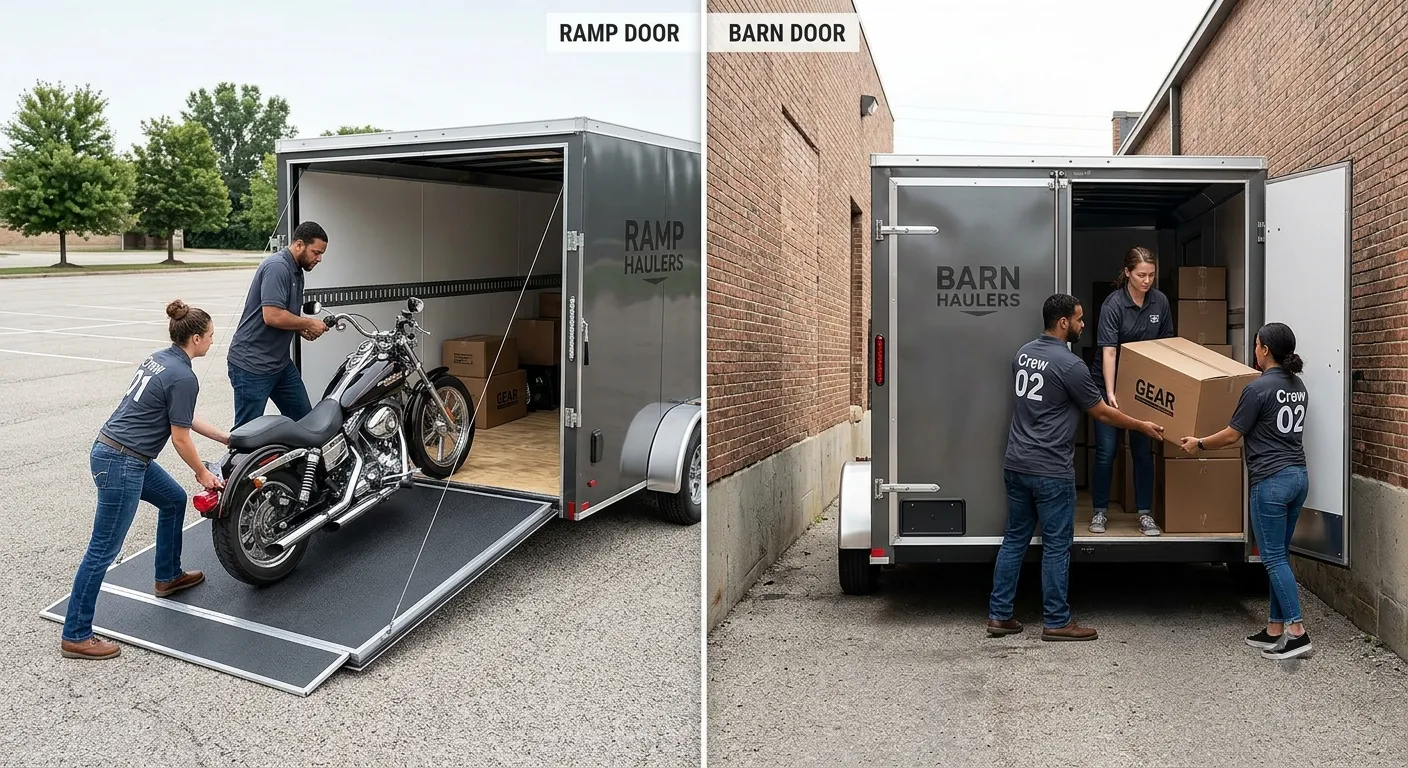
A ramp door creates a built-in loading surface for rolling cargo. Barn doors swing open like two rear entry doors, giving fast access and better flexibility in tight spaces. Neither option is automatically better for everyone. The right choice depends on what you haul, how often you load and unload, where you park, whether you use equipment with wheels, and whether your trailer needs to work like storage, a mobile business unit, or a jobsite tool room.
For buyers comparing enclosed trailers for landscaping, construction, mobile detailing, motorcycles, ATVs, UTVs, delivery work, event equipment, moving, or general cargo, the rear door is more than a convenience feature. It affects workflow, safety, parking clearance, loading speed, cargo organization, and long-term satisfaction with the trailer.
- What Is a Ramp Door on an Enclosed Trailer?
- What Are Barn Doors on an Enclosed Trailer?
- Quick Answer: Which Door Is Better?
- Ramp Door vs. Barn Doors: Simple Comparison
- When a Ramp Door Makes the Most Sense
- Advantages of Ramp Doors
- Disadvantages of Ramp Doors
- When Barn Doors Make the Most Sense
- Advantages of Barn Doors
- Disadvantages of Barn Doors
- Best Door for Landscaping Trailers
- Best Door for Motorcycles, ATVs, and UTVs
- Best Door for Contractors
- Best Door for Mobile Detailing and Pressure Washing
- Best Door for Delivery, Moving, and Boxed Cargo
- Parking Space: One of the Most Overlooked Factors
- Loading Safety: What Buyers Should Think About
- Door Choice and Trailer Size
- Ramp Door vs. Barn Doors for Security
- Weather Protection and Maintenance
- Can You Add a Side Door?
- Can You Use Barn Doors With Portable Ramps?
- Can a Ramp Door Be Too Much for Some Buyers?
- Door Choice by Buyer Type
- The Most Important Questions to Ask Before Choosing
- Ramp Door vs. Barn Doors: Final Recommendation
- How Make My Trailer Helps Buyers Compare Door Styles
- Frequently Asked Questions
- Conclusion
What Is a Ramp Door on an Enclosed Trailer?
A ramp door is a large rear door that folds down from the back of the trailer and becomes a loading ramp. Instead of carrying separate loading ramps, the trailer itself gives you a built-in loading surface. Many ramp doors are spring-assisted to make opening and closing easier, especially on larger enclosed trailers.
Ramp doors are commonly chosen by customers who load wheeled equipment, including lawn mowers, motorcycles, ATVs, UTVs, pressure washers, tool carts, dollies, vending machines, generators, mobile detailing equipment, and rolling storage cabinets. They are also useful for buyers who want one-person loading to be more manageable.
A ramp door is especially helpful when the cargo is heavy, awkward, or difficult to lift by hand. Instead of raising the equipment into the trailer, you can roll it in.
What Are Barn Doors on an Enclosed Trailer?
Barn doors are two rear doors that swing open from the center. They do not fold down into a ramp. Instead, they provide a wide rear opening for walk-in access, boxed cargo, hand-loaded materials, pallets, furniture, tools, and general supplies.
Barn doors are popular with buyers who do not always need a ramp or who often park in places where there is not enough room behind the trailer for a full ramp door to lower. They are also useful around warehouses, alleys, driveways, docks, storage yards, and jobsites where rear clearance is limited.
Because barn doors swing open instead of dropping to the ground, they can make quick access easier. A contractor, delivery driver, or mobile service provider can open one or both doors, grab tools or materials, and close the trailer without lowering a large ramp each time.
Quick Answer: Which Door Is Better?
For rolling equipment, a ramp door is usually the better choice.
For quick access, tight spaces, boxed cargo, dock loading, and hand-loaded materials, barn doors may be the better choice.
The better question is not “Which door is best?” The better question is: “Which door matches the way I load, unload, park, and work?”
Ramp Door vs. Barn Doors: Simple Comparison
| Feature | Ramp Door | Barn Doors |
|---|---|---|
| Best for rolling equipment | Excellent | Requires separate ramps |
| Best for tight rear clearance | Not ideal | Excellent |
| Best for motorcycles, ATVs, mowers | Excellent | Possible, but less convenient |
| Best for boxed cargo and hand loading | Good | Excellent |
| Best for forklift or dock loading | Sometimes limited | Often better |
| Best for frequent walk-in access | Good, but slower | Excellent |
| Requires space behind trailer | Yes | Less rear length needed |
| Built-in loading surface | Yes | No |
| Separate ramps needed | Usually no | Yes, if loading rolling cargo |
| Works well for jobsite quick access | Good | Excellent |
| Works well for mobile business setups | Depends on equipment | Depends on workflow |

When a Ramp Door Makes the Most Sense
A ramp door is usually the right choice when the trailer will carry equipment that rolls.
This includes:
For landscapers, a ramp door can save time every day because mowers and lawn care tools are constantly moving in and out. For motorcycle and powersports buyers, the ramp door makes loading easier because the trailer already has the entry surface built in. For contractors, a ramp door is helpful when using dollies, carts, compressors, or other wheeled equipment.
A ramp door can also be a good choice when the trailer functions as a mobile workshop. If the trailer has shelving, cabinets, E-track, tool storage, a generator, or a workbench, the ramp can serve as a loading surface for supplies and equipment that need to be rolled in and out.
Advantages of Ramp Doors
1. Easier Loading for Wheeled Equipment
The biggest advantage is convenience. A ramp door lets users roll cargo directly into the trailer. This can reduce lifting, speed up loading, and make the trailer more practical for daily work.
2. No Need to Carry Separate Ramps
With barn doors, buyers who haul motorcycles, mowers, or ATVs often need separate loading ramps. Those ramps take up space, add weight, and must be stored securely. A ramp door solves that problem by becoming the loading ramp.
3. Better for One-Person Loading
A ramp door can make loading more manageable when one person is working alone. This is especially useful for small business owners who load equipment daily without a crew.
4. Better for Landscapers and Powersports Owners
Landscaping equipment, motorcycles, dirt bikes, ATVs, and small machines are easier to load with a built-in ramp. Buyers in these categories often benefit most from a ramp door.
5. Good for Dollies, Carts, and Heavy Tools
Contractors, movers, delivery businesses, event companies, mobile mechanics, and service providers often use carts and dollies. A ramp door makes this type of loading much easier.
Disadvantages of Ramp Doors
1. Requires More Space Behind the Trailer
A ramp door needs room to lower fully. If the trailer is parked close to a wall, fence, garage door, loading area, another vehicle, or a tight alley, the ramp may not open. This matters for customers who park in residential driveways, small commercial lots, storage yards, urban jobsites, or narrow warehouse areas.
2. Heavier to Open and Close
Ramp doors can be larger and heavier than barn doors. Spring assist helps, but buyers should still consider how often they will open and close the door.
3. Ramp Angle Can Matter
If the trailer sits high, or if the cargo has low ground clearance, the ramp angle can become important. Motorcycles, low equipment, rolling toolboxes, and certain machines may need a smoother transition.
4. Must Match the Cargo Weight
Not all ramp doors are rated the same. Buyers should confirm the ramp door capacity and make sure it matches the equipment being loaded.
5. Less Convenient for Quick Grab-and-Go Access
If the goal is simply to open the rear, grab a box, and leave, lowering a ramp every time can feel slower than opening barn doors.

When Barn Doors Make the Most Sense
Barn doors are usually better when the trailer is used for hand-loaded cargo, boxed materials, furniture, tools, jobsite supplies, pallets, or quick rear access.
They are also a strong choice when the trailer is often parked in tight places. Because barn doors swing open instead of lowering to the ground, they can be easier to use when there is not enough rear clearance for a ramp.
Barn doors may be ideal for:
Advantages of Barn Doors
1. Better Rear Access in Tight Spaces
Barn doors are often easier to use in small parking areas, alleys, driveways, storage lots, and warehouses. You do not need a full ramp-length space behind the trailer.
2. Faster Walk-In Access
For quick access, barn doors are hard to beat. You can open one side or both sides depending on what you need. This is useful when grabbing tools, boxes, parts, or supplies throughout the day.
3. Good for Forklift and Dock Loading
Barn doors are often more practical when loading from a dock or using a forklift. A ramp door may get in the way in some dock or warehouse situations, while barn doors can open fully and leave the rear threshold clear.
4. Cleaner for Hand-Loaded Cargo
When loading boxes, furniture, event equipment, materials, or tools by hand, barn doors can feel simpler. There is no ramp to lower and no ramp surface to walk up.
5. Can Work With Separate Ramps
If you only occasionally load rolling equipment, barn doors can still work with portable ramps. This gives some flexibility without committing to a full ramp door.
Disadvantages of Barn Doors
1. No Built-In Ramp
This is the biggest drawback. If you regularly load mowers, motorcycles, ATVs, carts, or equipment on wheels, barn doors may create extra work.
2. Separate Ramps Must Be Stored
Portable ramps need storage space inside the trailer or tow vehicle. They also need to be secured while traveling.
3. Not as Convenient for Daily Equipment Loading
A landscaper loading mowers every day or a motorcycle owner hauling bikes every weekend will usually find a ramp door more practical.
4. Door Swing Still Needs Side Clearance
Barn doors need less rear length than a ramp, but the doors still need room to swing open. If the trailer is parked very close to obstacles on both sides, this can matter.
Best Door for Landscaping Trailers
For landscaping, a ramp door is usually the best option. Lawn care businesses often load and unload mowers, blowers, trimmers, fuel cans, spreaders, and other equipment several times a day. A ramp door allows mowers and wheeled equipment to roll directly into the trailer.
For landscapers, the rear door should also be considered along with floor strength, tie-down points, ventilation, side door access, shelving, wall protection, ladder racks, and axle capacity. A ramp door works especially well on 6x12, 7x14, 8.5x16, and larger enclosed trailers used for lawn care operations.
Barn doors may still work for landscapers who mainly carry hand tools, boxed products, or supplies, but most mower-heavy setups benefit from a ramp.
Best Door for Motorcycles, ATVs, and UTVs
For motorcycles, dirt bikes, ATVs, and many UTVs, a ramp door is usually the preferred choice. It creates a wide loading surface and reduces the need to carry separate ramps.
Powersports buyers should also think about:
A ramp door does not replace safe loading habits. Buyers should still use properly rated tie-downs, secure machines so they cannot shift, and confirm the trailer’s GVWR, payload capacity, and axle rating.
Best Door for Contractors
Contractors can go either way depending on workflow.
A ramp door is better if the contractor uses rolling equipment, carts, dollies, compressors, tool chests, floor machines, or heavy materials that are easier to roll than lift.
Barn doors are better if the contractor mostly loads tools, boxes, lumber, supplies, small parts, hardware bins, or jobsite materials by hand. Barn doors can also be more practical when the trailer is parked at tight jobsites where a ramp cannot drop fully.
For electricians, plumbers, HVAC technicians, flooring installers, remodelers, painters, and handymen, the best setup may include barn doors plus a side door for access. For contractors with rolling tool carts or heavier equipment, a ramp door may be more efficient.
Best Door for Mobile Detailing and Pressure Washing
Mobile detailing and pressure washing setups often include water tanks, generators, pressure washers, hoses, reels, chemical storage, shelves, cabinets, and electrical systems.
A ramp door helps if the business frequently rolls equipment in and out of the trailer. Barn doors can work well if most of the equipment stays mounted inside and the owner mainly needs quick rear access.
For mobile service businesses, the decision should be based on whether the trailer is used more for loading and unloading or as a fixed mobile workspace.
Best Door for Delivery, Moving, and Boxed Cargo
Barn doors are often the better choice for delivery businesses, furniture movers, event companies, and buyers hauling boxed cargo. The ability to open the rear quickly and access cargo without lowering a ramp can save time.
Barn doors may also work better when trailers are loaded near docks, warehouses, or areas where a ramp would interfere with loading.
However, if the business uses dollies or rolling carts every day, a ramp door may still be worth choosing.
Parking Space: One of the Most Overlooked Factors
Many buyers focus on cargo type but forget to think about parking space. This is a mistake.
A ramp door needs enough open space behind the trailer to lower completely. If you park in a short driveway, storage unit row, warehouse bay, narrow street, or busy jobsite, a ramp door can be inconvenient if there is no room behind the trailer.
Barn doors do not require the same rear length clearance. They still need room to swing open, but they are usually easier to manage when rear space is limited.
Before choosing a door, buyers should ask:
Loading Safety: What Buyers Should Think About
Door choice affects convenience, but safety still depends on correct loading and securement.
Before loading, buyers should confirm:
For rolling cargo, the trailer should have secure tie-down points such as D-rings, recessed anchors, or E-track. Equipment should be restrained so it cannot shift forward, backward, side to side, or roll while in transit.
For motorcycles, ATVs, UTVs, mowers, and equipment, wheel chocks, quality straps, and properly rated anchors are important. Heavy equipment should be loaded carefully, balanced properly, and secured before the trailer moves.
Door Choice and Trailer Size
Door selection should be reviewed together with trailer size. A small enclosed trailer with barn doors may be perfect for tools and boxes, while a larger enclosed trailer with a ramp door may be better for equipment.
Common examples:
Ramp Door vs. Barn Doors for Security
Both door styles can be secure when properly built and locked. The difference is usually not security alone, but access style.
Ramp doors provide a large rear panel that closes flat against the trailer. Barn doors have two swinging panels with a center latch area. Buyers should look at hinge quality, latch quality, lock options, weather seals, frame construction, and how the rear door integrates with the trailer body.
For business users, additional security upgrades may include:
A secure trailer is not only about the rear door. It is about the full setup.
Weather Protection and Maintenance
Enclosed trailers protect cargo from weather, road debris, sun exposure, and theft risk, but the rear door still needs maintenance.
Ramp doors should be inspected for:
Barn doors should be inspected for:
For both styles, buyers should keep seals clean, inspect for leaks, lubricate moving parts when recommended, and repair damaged hardware early.
Can You Add a Side Door?
A side door can make either rear door style more practical.
With a ramp door, a side door gives quick access without lowering the ramp. This is very useful when cargo blocks the rear or when a buyer only needs to grab a tool.
With barn doors, a side door can provide another entry point when the rear is parked near a wall, vehicle, dock, or jobsite obstacle.
For business trailers, a side door is often one of the most useful upgrades because it improves daily access and organization.
Can You Use Barn Doors With Portable Ramps?
Yes, barn doors can be used with portable ramps when the trailer and ramps are properly matched. This can be a good solution for buyers who only occasionally load rolling equipment.
However, portable ramps must be rated for the cargo, secured properly, stored safely, and positioned correctly. For frequent equipment loading, a built-in ramp door is usually simpler and more efficient.
Can a Ramp Door Be Too Much for Some Buyers?
Yes. If a buyer mostly hauls boxes, supplies, tools, furniture, or materials by hand, a ramp door may not be necessary. It may add weight and require more rear clearance than the buyer wants.
This is why barn doors remain a strong choice. They are simple, fast, and practical for many cargo-focused users.

Door Choice by Buyer Type
Landscapers
Choose a ramp door in most cases. Mowers and rolling equipment are much easier to load with a ramp.
Motorcycle Owners
Choose a ramp door. It makes loading safer and more convenient when paired with tie-downs and wheel chocks.
ATV and UTV Owners
Choose a ramp door if the machine fits the trailer’s width, height, and ramp rating.
Contractors
Choose ramp doors if using carts and rolling equipment. Choose barn doors if hauling tools, boxes, supplies, and hand-loaded materials.
Mobile Detailers
Choose based on layout. Ramp doors help when rolling equipment in and out. Barn doors work if the trailer is a fixed mobile workspace.
Delivery Businesses
Barn doors often work best for fast rear access, boxed cargo, and dock loading.
Furniture Movers
Barn doors can be practical for hand loading, but ramp doors help when using dollies.
Event Companies
Either can work. Ramp doors help with carts and rolling cases. Barn doors help with fast access and boxed equipment.
First-Time Buyers
Think about the cargo first. If it rolls, ramp door. If it is mostly carried, stacked, boxed, or loaded by hand, barn doors may be enough.
The Most Important Questions to Ask Before Choosing
Before ordering an enclosed trailer, buyers should ask:
These questions matter because the right door style depends on the full trailer setup, not one feature by itself.

Ramp Door vs. Barn Doors: Final Recommendation
Choose a ramp door if you regularly load rolling equipment, motorcycles, ATVs, UTVs, mowers, dollies, tool carts, detailing equipment, or heavy items that are difficult to lift. A ramp door is usually the most practical choice for landscapers, powersports owners, and mobile businesses that move equipment in and out frequently.
Choose barn doors if you need fast rear access, load by hand, work in tight spaces, use a dock or forklift, or haul boxed cargo, tools, supplies, materials, furniture, or inventory. Barn doors are often the better choice for buyers who want simplicity and flexibility without needing a built-in ramp every day.
The best enclosed trailer door is the one that matches how the trailer will actually be used.
How Make My Trailer Helps Buyers Compare Door Styles
Make My Trailer helps customers compare ramp doors, barn doors, trailer sizes, axle setups, interior layouts, and custom enclosed trailer options before ordering. The company works with buyers who need enclosed trailers for work, business, equipment hauling, mobile services, recreation, and everyday cargo protection.
Because each buyer’s workflow is different, Make My Trailer encourages customers to think through how they load, unload, park, organize, and secure their trailer. A landscaper, mobile detailer, contractor, motorcycle owner, delivery business, and first-time trailer buyer may all need different rear door setups.
Make My Trailer offers factory-direct enclosed trailers, custom trailer builds, stock trailer options, and pickup support from its Douglas, Georgia location. Buyers can compare door styles, trailer sizes, axle configurations, flooring, E-track, shelving, ladder racks, lighting, ventilation, insulation, extra height, and other custom features before deciding.
Frequently Asked Questions
Is a ramp door better than barn doors on an enclosed trailer?
A ramp door is better for rolling equipment and frequent loading. Barn doors are better for quick access, tight spaces, hand-loaded cargo, and dock-style loading.
Which trailer door is better for motorcycles?
A ramp door is usually better for motorcycles because it creates a built-in loading surface. Buyers should also use proper tie-downs, wheel chocks, and safe loading practices.
Which trailer door is better for lawn equipment?
A ramp door is usually better for lawn equipment because mowers and other landscaping machines can roll directly into the trailer.
Which trailer door is better for contractors?
It depends on the work. Contractors who use rolling carts and equipment often prefer ramp doors. Contractors who mostly carry tools, boxes, and materials may prefer barn doors.
Do barn doors work with ATVs or UTVs?
They can, but separate ramps are usually required. Buyers should confirm ramp rating, trailer width, trailer height, tie-down placement, and cargo dimensions before loading.
Do ramp doors require more space?
Yes. A ramp door needs enough space behind the trailer to lower fully. Barn doors usually work better when rear clearance is limited.
Are barn doors better for loading docks?
Barn doors are often more practical for docks, warehouses, and forklift loading because they swing open and keep the rear opening clear.
Can I add a side door with either rear door style?
Yes, many enclosed trailers can include a side door. A side door improves access whether the trailer has a ramp door or barn doors.
Which rear door is best for a mobile business?
It depends on whether equipment is moved in and out or stays installed inside the trailer. Ramp doors help with rolling equipment. Barn doors help with quick rear access.
What should I confirm before ordering?
Confirm cargo dimensions, cargo weight, trailer GVWR, payload capacity, axle setup, ramp door rating, tie-down layout, tow vehicle capacity, parking space, and whether the trailer needs custom options.
Conclusion
The choice between ramp doors and barn doors is not just about appearance. It is about daily use. A ramp door can make loading rolling equipment easier and reduce the need for separate ramps. Barn doors can make quick access easier and help when parking space is limited.
For buyers who haul motorcycles, ATVs, mowers, carts, and wheeled equipment, a ramp door is usually the right choice. For buyers who haul boxes, tools, furniture, materials, inventory, or dock-loaded cargo, barn doors may be the smarter setup.
Make My Trailer helps buyers compare both options so they can choose an enclosed trailer that fits their cargo, workflow, parking situation, and long-term hauling needs.
Ready to customize the perfect door and layout for your enclosed trailer?
Design Your Trailer at Make My Trailer