
New vs. Used Enclosed Trailers: What Buyers Should Consider Before Making a Decision
For many buyers, the first question is simple: should I buy a new or used enclosed trailer? At first glance, a used enclosed trailer may look like the cheaper choice. The purchase price is usually lower, the trailer may be available immediately, and some buyers assume that a cargo trailer is simple enough that age does not matter.
But enclosed trailers are more than empty boxes on wheels. They have roofs, seams, floors, axles, tires, brakes, wiring, lights, doors, hinges, latches, suspension parts, tie-down points, and structural components that all affect safety, usefulness, and long-term value. A used trailer can be a good purchase in the right situation, but buyers need to understand what they are actually buying before deciding that the lower price is the better deal.
Make My Trailer, a factory-direct enclosed trailer company based in Douglas, Georgia, encourages buyers to compare new and used enclosed trailers by looking at total cost, condition, warranty protection, repair risk, towing safety, business downtime, and whether the trailer can be configured for the buyer’s actual hauling needs.
- Why Buyers Compare New and Used Enclosed Trailers
- The Real Difference Between Price and Value
- When a Used Enclosed Trailer May Make Sense
- When a New Enclosed Trailer Is Usually the Better Choice
- New vs. Used Enclosed Trailer Comparison
- What to Check Before Buying a Used Enclosed Trailer
- Hidden Costs Buyers Often Miss
- The Risk of Buying a Used Trailer That Does Not Fit Your Needs
- Why Customization Is a Major Advantage of Buying New
- Warranty Protection and Ownership Confidence
- Resale Value: Why Documentation Matters
- New vs. Used for Specific Buyers (Contractors, Landscapers, etc.)
- Questions to Ask Before Buying a Used Enclosed Trailer
- Used Enclosed Trailer Inspection Checklist
- Questions to Ask Before Buying a New Enclosed Trailer
- How to Decide Between New and Used
- Frequently Asked Questions
- Final Buyer Advice
Why Buyers Compare New and Used Enclosed Trailers
Enclosed trailers are used for many different purposes. Contractors use them for tools and materials. Landscapers use them for mowers, trimmers, blowers, and fuel cans. Mobile detailers may use them for tanks, generators, pressure washers, hoses, chemicals, and storage. Motorcycle, ATV, and UTV owners use enclosed trailers to protect recreational equipment. Small business owners use them as secure mobile storage, delivery space, jobsite support, or even the foundation for a mobile service business.
Because enclosed trailers are used in so many ways, buyers often start by looking at both new and used options. The used market can be attractive because the upfront price may be lower. However, the actual value depends on much more than the asking price. A used trailer with old tires, weak flooring, roof leaks, worn brakes, bad bearings, electrical issues, or axle problems can quickly become more expensive than expected.
A new enclosed trailer, by comparison, gives the buyer a clean starting point. The trailer has no unknown work history, no hidden overload damage, no patched roof leak, and no mystery maintenance record. Buyers can choose the size, axle setup, door style, height, color, flooring, tie-down options, ventilation, electrical package, insulation, air conditioning, shelving, ladder racks, or other upgrades based on how they plan to use the trailer.
The best decision depends on the buyer’s budget, intended use, timeline, ability to inspect repairs, and tolerance for risk.
The Real Difference Between Price and Value
The biggest mistake buyers make is comparing only the purchase price.
A used enclosed trailer may cost less upfront, but the buyer should also calculate:
A new enclosed trailer may have a higher initial purchase price, but it may provide better long-term value if it includes warranty support, the right configuration, clean ownership history, current materials, updated specifications, and fewer immediate repair concerns.
The better question is not simply, “Which trailer is cheaper today?” The better question is, “Which trailer will cost less and work better over the next several years?”
When a Used Enclosed Trailer May Make Sense
A used enclosed trailer can still be a smart purchase in certain situations.
A used trailer may make sense if:
For example, someone who only needs a trailer for occasional light hauling may be comfortable buying a clean used trailer if it passes inspection. A buyer with mechanical experience may also be able to handle bearings, lights, brakes, latches, flooring, or sealant maintenance without paying a repair shop.
However, a used trailer is risky when the buyer cannot verify its history, condition, title, load rating, or structural integrity.
When a New Enclosed Trailer Is Usually the Better Choice
A new enclosed trailer often makes more sense when the trailer will be used for work, business, daily hauling, long-distance travel, or valuable equipment.
A new trailer may be the stronger choice if the buyer needs:
For contractors, landscapers, mobile service providers, and small business owners, downtime matters. A trailer that needs unexpected repairs can delay jobs, interrupt service, or prevent equipment from reaching the worksite. In those cases, a new factory-direct enclosed trailer can offer more confidence and predictability.
New vs. Used Enclosed Trailer Comparison
| Category | New Enclosed Trailer | Used Enclosed Trailer |
|---|---|---|
| Upfront price | Usually higher | Usually lower |
| Warranty | Often available | Often expired or limited |
| Condition | Clean starting point | Depends on history |
| Roof leaks | Lower risk when new | Must inspect carefully |
| Tires | New or current | May be aged even if tread looks good |
| Flooring | New and known | May have soft spots, rot, stains, or hidden water damage |
| Brakes and bearings | New or recently assembled | May need immediate service |
| Wiring and lights | New and properly installed | Can be patched, corroded, or unreliable |
| Axles | Known rating and condition | May show overload or alignment wear |
| Custom options | Can be selected before purchase | Limited to what already exists |
| Business readiness | Built for intended use | May need repair or modification |
| Resale value | Often stronger with documentation | Depends on age and condition |
| Risk level | Lower unknowns | Higher unknowns |

What to Check Before Buying a Used Enclosed Trailer
A used trailer inspection should be slow, detailed, and practical. Buyers should not inspect only the exterior paint, tires, or price tag. A trailer can look acceptable from the outside while hiding water damage, electrical problems, weak flooring, or axle issues.
1. Title, VIN, and Ownership Documents
Before inspecting the physical trailer, confirm the paperwork.
Check:
A trailer without clear documentation can create registration and resale problems. If the seller cannot explain the title, VIN, or ownership history, the buyer should be cautious.
2. GVWR, Payload, and Axle Rating
Many buyers misunderstand trailer weight. The size of the trailer does not automatically tell you how much it can safely carry.
Important terms include:
A used trailer may have been overloaded by a previous owner. Overloading can damage axles, tires, suspension, flooring, frame members, and the hitch area. Buyers should compare the trailer’s GVWR and axle rating to the equipment they plan to haul.
3. Roof Leaks and Water Damage
Roof leaks are one of the biggest hidden problems in used enclosed trailers. Water can enter through roof seams, vents, fasteners, trim, corner joints, old sealant, roof damage, or improperly installed accessories.
Inspect:
A small roof leak can become a large structural problem if water sits inside the walls or floor. Even if the roof has been resealed, buyers should ask when the leak occurred, how long it lasted, and whether damaged materials were replaced.
4. Flooring Strength
The floor should feel solid everywhere. Walk the entire floor slowly. Pay attention to flexing, dips, soft spots, stains, rot, swelling, patched sections, and loose fasteners.
Floor damage can come from:
Flooring matters because it supports the cargo. A trailer used for motorcycles, ATVs, mowers, pressure washing equipment, or contractor tools needs a strong floor. If the floor feels weak, repair costs should be calculated before purchase.
5. Frame and Underside
The underside tells the truth about how the trailer was used.
Inspect:
Surface rust may be manageable, but deep corrosion, cracked welds, bent frame members, or damaged suspension mounts are serious concerns. Buyers should be especially careful with trailers used in coastal areas, salted-road regions, or heavy commercial work.

6. Axles and Suspension
Axle condition affects towing stability, tire wear, payload safety, and long-term reliability.
Look for:
If a trailer pulls to one side, bounces unusually, or wears tires unevenly, the issue may be axle or suspension related. A used trailer with axle damage can become expensive quickly.
7. Tires: Age Matters as Much as Tread
A used trailer may have tires that look acceptable but are too old, under-rated, dry-rotted, or unevenly worn.
Check:
Trailer tires can age out before they wear out. This is especially important for trailers that sit outside or are used infrequently. A trailer with old tires should be priced with replacement in mind.
8. Brakes and Bearings
If the trailer has brakes, test them before buying. Electric brakes should engage smoothly and should be compatible with the tow vehicle’s brake controller. Bearings should be serviced regularly and should not make grinding noises, run hot, or show signs of neglect.
Check:
Neglected bearings can create serious roadside problems. If the seller cannot say when the bearings were last serviced, assume they need inspection.
9. Wiring, Lights, and Electrical Add-Ons
Trailer wiring issues can be frustrating because problems are not always visible.
Test:
Look for electrical tape, loose wires, corrosion, spliced connections, dangling harnesses, and wires rubbing against metal. A low-priced used trailer can quickly become less attractive if the electrical system needs professional repair.
10. Doors, Hinges, Latches, and Ramp Springs
Doors are not just convenience features. They affect security, weather protection, loading, and safety.
Inspect:
A ramp door should open and close smoothly. Barn doors should seal properly and latch securely. A side door should not sag or bind. Damaged hinges, weak springs, or misaligned doors can create safety and usability issues.
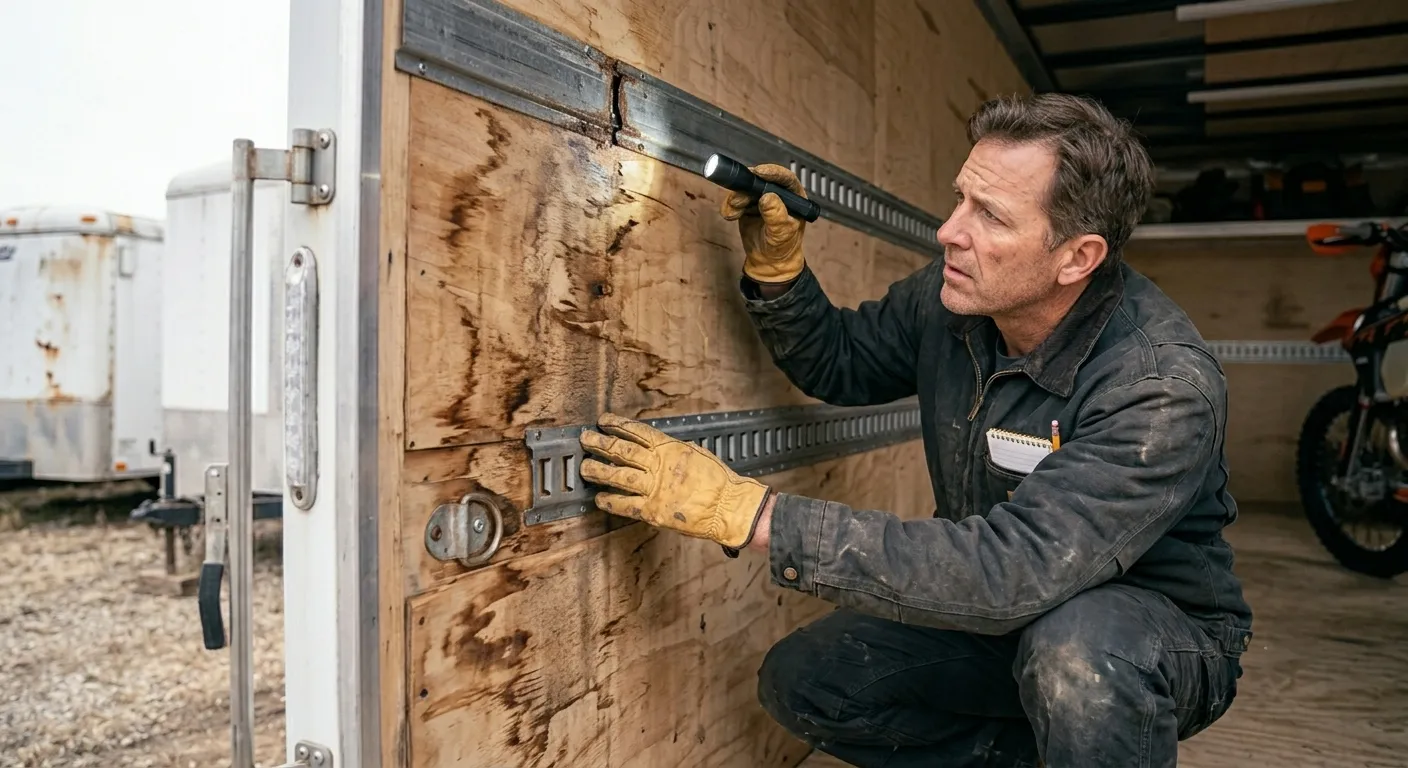
11. Tie-Downs, E-Track, D-Rings, and Interior Layout
A used enclosed trailer may already have tie-down points, shelving, racks, or E-track. That can be helpful, but buyers should inspect installation quality.
Check:
Poorly installed cargo control systems can fail when the trailer is moving. If the trailer will carry motorcycles, mowers, tools, or heavy equipment, secure tie-down points are essential.
12. Signs of Commercial Abuse
Some used enclosed trailers have worked hard for years. That does not automatically mean they are bad, but it does mean the buyer should inspect carefully.
Signs of heavy use include:
A heavily used trailer may still be useful, but the price should reflect its condition.
Hidden Costs Buyers Often Miss
A buyer may think they saved money on a used trailer, then quickly face additional costs.
Common hidden costs include:
A smart buyer should not just ask, “Can I afford the trailer?” They should ask, “Can I afford the trailer after repairs?”
The Risk of Buying a Used Trailer That Does Not Fit Your Needs
One of the biggest risks with a used trailer is buying the wrong configuration.
A used trailer may be available at the right price, but it may not be:
This matters because modification after purchase costs time and money. A landscaper may need a ramp door, ventilation, and durable flooring. A contractor may need ladder racks, shelving, interior lighting, and E-track. A mobile detailing business may need space for a water tank, generator, pressure washer, hoses, chemicals, and electrical upgrades. A motorcycle owner may need wheel chocks, D-rings, and a ramp door with the right loading angle.
If a used trailer does not match the job, the savings may disappear.

Why Customization Is a Major Advantage of Buying New
Customization is one of the strongest reasons to buy new. Instead of accepting whatever is available on the used market, buyers can choose the features that match their use case.
Popular enclosed trailer upgrades include:
For business owners, the right trailer setup can improve efficiency every day. A properly configured trailer can reduce loading time, protect tools, keep equipment organized, and make the business look more professional.
Warranty Protection and Ownership Confidence
Warranty protection is another major difference between new and used enclosed trailers. A used trailer may have no warranty at all, or the original warranty may not transfer. Even if the trailer looks good, the buyer may be responsible for every repair after purchase.
A new enclosed trailer may offer warranty support and clearer documentation. Buyers can ask about the manufacturer, warranty terms, covered components, service process, and maintenance expectations before ordering.
Warranty does not eliminate the need for maintenance, but it gives buyers more confidence than buying a trailer with unknown history.
Resale Value: Why Documentation Matters
Resale value should be part of the buying decision. A newer trailer with clear specifications, clean title, known manufacturer, desirable options, and maintenance records may be easier to sell later.
Features that can help resale value include:
A used trailer with uncertain history, water damage, old tires, weak flooring, or electrical problems may be harder to sell, even if the buyer paid less upfront.
New vs. Used for Specific Buyers
New vs. Used for Contractors
Contractors usually need reliability, organization, and secure tool storage. A used trailer may work if it is clean, dry, and already equipped with shelving or tie-downs. However, contractors should be cautious about leaks, weak flooring, door security, wiring, and axle condition.
A new trailer may be better for contractors who need:
For electricians, plumbers, remodelers, flooring installers, HVAC technicians, roofers, and general contractors, the trailer often becomes part of the business. Buying the correct setup from the start can save time on every job.
New vs. Used for Landscaping Businesses
Landscapers often load and unload equipment frequently. They may carry mowers, trimmers, blowers, fuel cans, tools, sprayers, and replacement parts. For landscaping use, buyers should pay close attention to floor strength, ramp condition, ventilation, tie-down points, axle rating, and tire condition.
A used trailer may make sense for a small startup if it is in good condition. A new trailer may be stronger for a growing lawn care business that wants a ramp door, vents, shelving, ladder racks, durable flooring, and a professional appearance.
New vs. Used for Mobile Detailing Businesses
Mobile detailing trailers often require a more specialized setup. A trailer may need room for a water tank, pressure washer, hose reels, generator, chemicals, storage, ventilation, and electrical support.
A used trailer may not have the right layout or may require expensive modifications. A new enclosed trailer allows the buyer to plan the interior around the business workflow from the beginning.
New vs. Used for Motorcycle, ATV, and UTV Owners
Recreational buyers often focus on whether the trailer fits the machine. That is important, but they should also consider loading angle, ramp strength, interior height, tie-down placement, wheel chocks, ventilation, and floor condition.
A used trailer may be acceptable if the floor is strong, the ramp works properly, and the tie-down points are secure. A new trailer may be better if the buyer needs a specific size, interior height, ramp door, D-rings, E-track, or wheel chock layout.

Questions to Ask Before Buying a Used Enclosed Trailer
Before buying a used trailer, ask the seller:
If the seller cannot answer basic questions, proceed carefully.
Used Enclosed Trailer Inspection Checklist
Before paying for a used trailer, inspect:
If possible, have a qualified trailer repair shop inspect the trailer before purchase.
Questions to Ask Before Buying a New Enclosed Trailer
Before ordering a new enclosed trailer, ask:
These questions help buyers avoid ordering a trailer that is too small, too weak, or missing important features.
How to Decide Between New and Used
A used enclosed trailer may be the right choice if the trailer is clean, dry, properly documented, structurally sound, correctly rated, and priced low enough to justify its age and condition.
A new enclosed trailer may be the better choice if the buyer wants warranty protection, a clean start, known specifications, customization flexibility, business reliability, better long-term value, and less risk of surprise repairs.
The decision should be based on total value, not just the initial price.
Frequently Asked Questions
Should I buy a new or used enclosed trailer?
Buy used if the trailer is in excellent condition, properly documented, priced fairly, and fits your needs without major repairs. Buy new if you want warranty protection, customization, clean ownership history, and fewer unknowns.
Is a used enclosed trailer worth it?
A used enclosed trailer can be worth it if it has no leaks, strong flooring, good tires, working lights, proper brakes, solid axles, and a clean title. It may not be worth it if repair costs erase the savings.
What should I check before buying a used enclosed trailer?
Check the roof, seams, ceiling, walls, floor, tires, axles, brakes, bearings, wiring, lights, frame, doors, hinges, latches, title, VIN, GVWR, and payload rating.
Why do roof leaks matter so much?
Water can damage ceiling panels, walls, insulation, wood flooring, fasteners, and cargo. A roof leak that looks small may indicate long-term hidden damage.
How do I check trailer tire age?
Look for the DOT Tire Identification Number on the tire sidewall. The last four digits identify the week and year the tire was manufactured. Old trailer tires may need replacement even if they still have tread.
Are brakes important on an enclosed trailer?
Yes. Brakes improve stopping control, especially on heavier trailers. Buyers should confirm whether the trailer has brakes, whether they work, and whether the tow vehicle has the correct brake controller.
Is customization worth paying for?
Customization is worth it when it makes the trailer better for the job. E-track, D-rings, racks, ventilation, insulation, electrical upgrades, A/C, extra height, and upgraded flooring can all improve usability.
Does a new trailer have better resale value?
A newer trailer with known specifications, good documentation, desirable options, clean condition, and warranty history may be easier to resell than an older trailer with uncertain maintenance history.
Can a used trailer be modified later?
Yes, but modifications add cost and may not be as clean as ordering the right configuration from the beginning. Buyers should compare the cost of modifications against the cost of buying new.
What is the safest choice for business owners?
For business owners who rely on the trailer daily, a new enclosed trailer is often the safer long-term choice because downtime, repairs, leaks, and poor configuration can interrupt work.
Final Buyer Advice
Buying an enclosed trailer is not just about finding a box on wheels. It is about choosing a hauling solution that protects equipment, supports daily work, tows safely, and holds value over time.
Used trailers can be worthwhile, but buyers should inspect carefully and calculate repairs honestly. New trailers can cost more upfront, but they often provide better predictability, warranty support, and the ability to configure the trailer correctly from day one.
For buyers comparing new enclosed trailers, used enclosed trailers, custom builds, and available stock units, Make My Trailer helps customers evaluate trailer size, axle setup, door style, upgrades, pricing, and pickup options before ordering.
Ready to invest in a reliable, fully customized trailer for your business?
Explore New Trailers at Make My Trailer