
Factory-Direct Enclosed Trailer Buying Guide: How to Compare Size, Axle Setup, Custom Options, Pickup, and Delivery
Buying an enclosed trailer is not just about choosing a box on wheels. For many contractors, landscapers, mobile service businesses, motorcycle owners, and first-time buyers, an enclosed trailer becomes part of their daily work, storage system, equipment protection plan, and long-term business investment. That is why the factory-direct buying process can be so valuable: it helps customers compare real trailer needs before committing to a size, axle setup, door style, or upgrade package.
Make My Trailer, a factory-direct enclosed trailer company based in Douglas, Georgia, helps buyers across the United States compare enclosed cargo trailer sizes, axle configurations, custom options, stock availability, and pickup or delivery discussions before ordering. Instead of shopping only by price or relying on generic online trailer listings, buyers can focus on the actual details that determine whether a trailer will work for their cargo, tow vehicle, business use, and future plans.
This guide explains how factory-direct enclosed trailer buying works, what buyers should compare, which questions matter most, and how to choose a trailer setup that fits the job.
- What Does Factory-Direct Enclosed Trailer Buying Mean?
- Why Buyers Should Not Choose an Enclosed Trailer Based on Price Alone
- Step 1: Choose the Right Enclosed Trailer Size
- Step 2: Compare Single Axle vs. Tandem Axle Enclosed Trailers
- Step 3: Understand GVWR, Payload, Empty Weight, and Tongue Weight
- Step 4: Choose Between Ramp Doors and Barn Doors
- Step 5: Decide Whether Extra Height Is Worth It
- Step 6: Review Custom Options Before Ordering
- Step 7: Think About Interior Layout Before Buying
- Step 8: Compare Stock Trailers vs. Custom Builds
- Step 9: Request a Quote or Reservation
- Step 10: Prepare for Pickup in Georgia
- Step 11: Discuss Delivery Options When Needed
- Enclosed Trailer Buying Questions Every Customer Should Ask
- Best Enclosed Trailer Setups by Use Case
- Why Factory-Direct Buying Helps Customers Make Better Decisions
- Final Thoughts: The Right Enclosed Trailer Should Fit the Work, the Tow Vehicle, and the Future
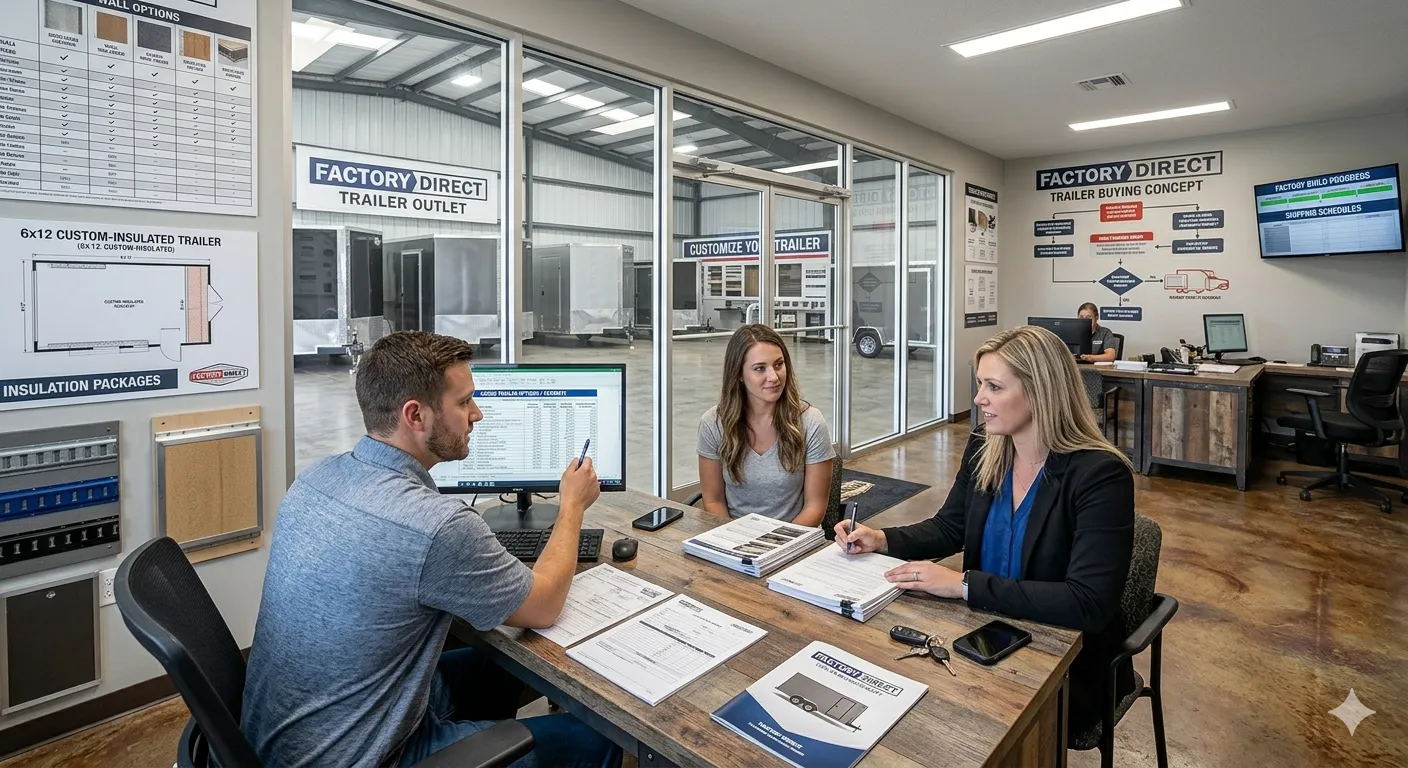
What Does Factory-Direct Enclosed Trailer Buying Mean?
Factory-direct trailer buying means the customer works closer to the trailer source rather than shopping only through traditional middle layers. The goal is to make the buying process more direct, more specific, and more focused on the trailer configuration the customer actually needs.
For enclosed cargo trailers, this can be especially helpful because two trailers that look similar from the outside may be very different in practical use. A 6x12 single axle trailer with a ramp door is not the same buying decision as a 7x14 tandem axle trailer with extra height, E-track, insulation, and upgraded lighting. A contractor hauling tools has different needs than a mobile detailer, landscaper, motorcycle owner, or general homeowner.
A factory-direct buying process usually includes:
This process helps buyers move from “I need an enclosed trailer” to “I know which enclosed trailer setup makes sense for my cargo, towing needs, and budget.”
Why Buyers Should Not Choose an Enclosed Trailer Based on Price Alone
Price matters, but the cheapest enclosed trailer is not always the best value. A buyer who chooses only by price may end up with the wrong size, too little payload, poor cargo access, no ventilation, weak organization options, or a trailer that cannot grow with the business.
Before comparing price, buyers should understand:
Factory-direct buying helps customers compare value, not just sticker price. A properly configured trailer may cost more up front but save money over time by reducing repairs, improving daily efficiency, protecting tools, and preventing the need to upgrade too soon.
Step 1: Choose the Right Enclosed Trailer Size
Trailer size is usually the first major decision. The right size depends on what the customer hauls, how much room is needed to move around inside, and whether the buyer wants room for future growth.
Common enclosed trailer sizes include:
- 5x8 enclosed trailers for compact cargo, household hauling, small tools, and light-duty use
- 6x10 enclosed trailers for buyers who need a little more room while keeping towing simple
- 6x12 enclosed trailers for contractors, small businesses, motorcycles, landscaping tools, and general cargo
- 7x14 enclosed trailers for larger equipment, more organized interiors, and heavier business use
- 8.5x16 enclosed trailers for wider cargo, multiple machines, and mobile business layouts
- 8.5x20 enclosed trailers for larger business setups, motorsports, moving, and commercial hauling
- 8.5x24 enclosed trailers for car hauling, larger mobile operations, or high-capacity cargo needs
The most common mistake is buying too small. A trailer may fit the buyer’s current cargo, but it may not leave enough room for tie-down angles, shelving, cabinets, ladders, equipment spacing, or future tools. For business owners, it is often better to think one or two years ahead.
A landscaper may start with one mower and a few handheld tools, then later add another mower, fuel cans, blowers, trimmers, and racks. A contractor may begin with basic tools but later need shelving, E-track, material storage, lighting, and a workbench. A motorcycle owner may start with one bike but later want room for gear, cabinets, or a second motorcycle.
The best size is not always the biggest. The best size is the smallest trailer that safely and comfortably handles the job while leaving enough room for practical use and future growth.

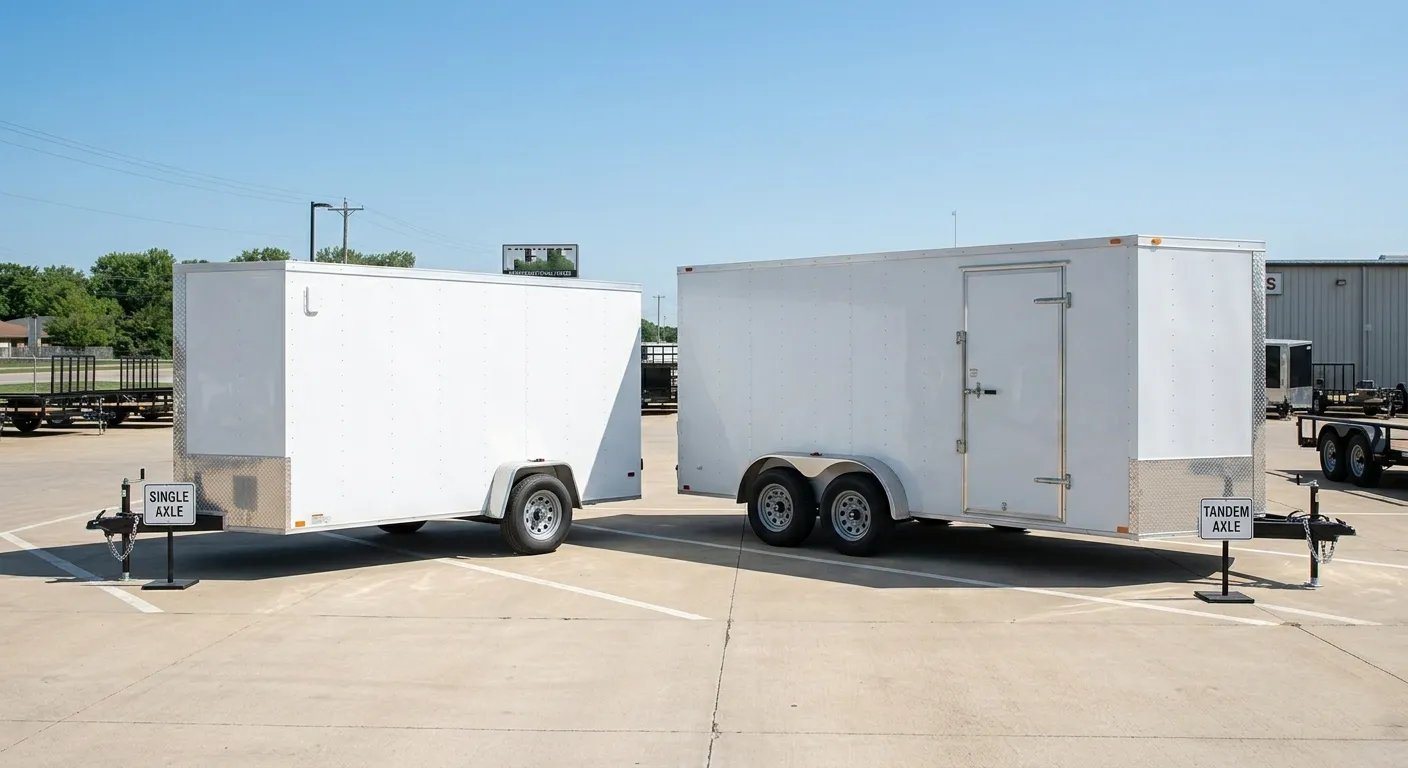
Step 2: Compare Single Axle vs. Tandem Axle Enclosed Trailers
Axle setup affects payload, towing feel, stability, maintenance, cost, and long-term use.
Single Axle Enclosed Trailers
A single axle trailer has one axle and is usually lighter, easier to maneuver, and more affordable. It can be a strong choice for smaller sizes and moderate cargo loads.
Single axle trailers are commonly used for:
- Light tools
- Small business equipment
- Motorcycles
- ATVs
- Household cargo
- Event supplies
- Small lawn equipment
- Mobile hobby setups
Benefits of a single axle trailer include:
However, a single axle trailer may not be the best choice for frequent heavy loads, long-distance commercial hauling, or cargo that pushes the upper limits of the trailer’s payload rating.
Tandem Axle Enclosed Trailers
A tandem axle trailer has two axles. It usually costs more and weighs more, but it can provide better stability, higher payload capacity, smoother towing, and added confidence for heavier use.
Tandem axle trailers are commonly used for:
- Heavier tools and machines
- Landscaping businesses
- Contractors
- Mobile service businesses
- Car hauling
- Long-distance hauling
- Frequent highway travel
- Larger enclosed trailer sizes
Benefits of a tandem axle trailer include:
The tradeoff is higher purchase cost, more tires, more components, and greater empty weight. Buyers should choose tandem axle when their cargo, towing frequency, travel distance, or business use justifies it.
Step 3: Understand GVWR, Payload, Empty Weight, and Tongue Weight
One of the most important parts of buying an enclosed trailer is understanding weight. Many first-time buyers ask, “How much can this trailer carry?” The answer depends on several ratings.
GVWR, or Gross Vehicle Weight Rating, is the maximum total loaded weight of the trailer and its cargo. Empty trailer weight is the weight of the trailer before cargo is added. Payload capacity is usually calculated by subtracting empty trailer weight from GVWR.
For example, if a trailer has a GVWR of 3,500 pounds and an empty weight of 1,200 pounds, the estimated payload capacity is 2,300 pounds. The actual payload may vary depending on options, materials, axle rating, and installed equipment.
Tongue weight is the downward force the loaded trailer places on the hitch. Too little tongue weight can contribute to sway. Too much tongue weight can overload the tow vehicle’s rear axle and affect steering or braking. Buyers should confirm the trailer’s loaded weight, tongue weight, hitch rating, and tow vehicle capacity before hauling.
Important questions include:
For business buyers, this is not optional. A trailer that is overloaded or matched with the wrong tow vehicle can create safety risks, damage equipment, increase wear, and cause legal or insurance problems.
Step 4: Choose Between Ramp Doors and Barn Doors
Door style affects daily convenience more than many buyers expect.
Ramp Door
A ramp door is usually best when cargo rolls into the trailer. It is common for:
- Lawn mowers
- Motorcycles
- ATVs
- UTVs
- Tool carts
- Pressure washers
- Mobile detailing equipment
- Rolling cases
- Small machines
A ramp door makes loading easier because the rear door becomes the ramp. For landscapers, motorcycle owners, and mobile service businesses, this is often the most practical choice.
Barn Doors
Barn doors are two swinging rear doors. They can be a better fit for:
- Boxes
- Pallet-style loading
- Hand-carried tools
- Jobsite materials
- Cargo accessed in tight spaces
- Buyers who do not want a heavy ramp door
Barn doors may be easier to open when space behind the trailer is limited. They can also be convenient for delivery-style use where cargo is hand-loaded or forklift-loaded near the rear.
The best choice depends on how cargo enters the trailer. If equipment rolls in, choose a ramp door. If cargo is mainly hand-loaded or accessed in tight spaces, barn doors may be better.
Step 5: Decide Whether Extra Height Is Worth It
Standard interior height may be enough for many buyers, but extra height can make a trailer more comfortable and useful.
Extra height can help when:
Extra height may increase wind resistance and trailer weight, but for contractors and mobile service businesses, the convenience can be worth it. Buyers should measure their tallest cargo and also consider the human workspace inside the trailer.

Step 6: Review Custom Options Before Ordering
One advantage of factory-direct buying is that buyers can review options before the trailer is built or reserved. Custom options can turn a basic cargo trailer into a business-ready trailer.
Common enclosed trailer upgrades include:
- E-track or D-rings for cargo control
- Insulation for temperature control
- A/C preparation or A/C installation
- Roof vents or side vents
- Extra interior height
- Ladder racks
- Interior lighting
- Electrical packages
- Shelving and cabinets
- Wall protection
- Floor upgrades
- Ramp door upgrades
- Side door upgrades
- Spare tire mounts
- Blackout packages
- Awning options
- Concession or mobile business layouts
The key is to match options to the use case.
A landscaper may need a ramp door, floor durability, ladder racks, vents, and tie-down points. A contractor may need shelving, E-track, wall hooks, side access, and lighting. A mobile detailer may need room for a water tank, generator space, ventilation, insulation, and organized storage. A motorcycle owner may need wheel chocks, D-rings, E-track, interior lighting, and a ramp door.
Options should solve real problems. Buyers should avoid paying for upgrades that look good but do not improve daily use.
Step 7: Think About Interior Layout Before Buying
Interior layout is often overlooked. Buyers should think about where cargo will sit, how weight will be distributed, and how they will access tools or equipment.
A good trailer layout considers:
Cargo should be secured so it cannot shift during towing. Heavy items should be positioned carefully to maintain proper balance. Tools should be stored in a way that prevents damage and saves time at job sites.
For contractors, trailer organization can directly affect productivity. A disorganized trailer wastes time every day. A well-planned trailer can work like a mobile shop.
Step 8: Compare Stock Trailers vs. Custom Builds
Some buyers need a trailer quickly. Others need a specific setup. Factory-direct buying helps clarify whether a stock trailer or custom build makes more sense.
Stock Trailers
A stock trailer may be best when:
- The buyer needs faster pickup
- The configuration already fits the job
- Standard size and features are acceptable
- Budget and timing are the top priorities
Stock trailers are often ready sooner, but customization may be limited.
Custom Builds
A custom build may be best when:
- The buyer needs specific size, height, doors, or axle setup
- Business use requires certain upgrades
- The trailer must match equipment dimensions
- A/C, insulation, E-track, racks, or special layouts are needed
- The buyer wants long-term efficiency instead of a quick purchase
Custom builds may take longer, but they can prevent costly compromises.
Step 9: Request a Quote or Reservation
Once the buyer understands size, axle setup, door style, options, and stock availability, the next step is to request a quote or reservation.
A good quote request should include:
The more specific the buyer is, the more accurate the quote can be. A buyer who says, “I need a 6x12 enclosed trailer for landscaping with a ramp door, ladder rack, side vents, E-track, and room for a mower,” will get better guidance than a buyer who only asks, “How much is a trailer?”

Step 10: Prepare for Pickup in Georgia
Make My Trailer’s factory-direct process includes preparing customers for pickup in Georgia or discussing available delivery options. Before pickup, buyers should confirm:
Before towing away, the buyer should check lights, coupler connection, safety chains, tires, lug nuts, doors, latches, and load balance. If the trailer has brakes, the brake controller should be properly set.
For long-distance pickup, buyers should also bring basic tools, a tire pressure gauge, spare tire if available, wheel chocks, straps, and emergency roadside items.
Step 11: Discuss Delivery Options When Needed
Not every buyer can pick up in Georgia. Delivery may be available or discussed depending on location, trailer type, timing, and logistics. Buyers should ask:
Delivery can be convenient, but pickup may allow buyers to save money or receive the trailer faster depending on inventory and distance.
Enclosed Trailer Buying Questions Every Customer Should Ask
Before ordering, buyers should ask:
These questions help buyers avoid the most common mistakes.
Best Enclosed Trailer Setups by Use Case
Landscaping Business
A landscaping trailer should prioritize loading, durability, and organization. Good options include a ramp door, reinforced floor, ladder racks, vents, D-rings or E-track, tool storage, and possibly extra height.
Contractor Trailer
Contractors often need shelving, cabinets, E-track, side door access, interior lighting, and secure tool storage. Electricians, plumbers, remodelers, flooring installers, roofers, and HVAC technicians may each need different layouts.
Mobile Detailing Trailer
Mobile detailing businesses may need room for a water tank, generator, hoses, reels, chemicals, shelving, ventilation, insulation, and flooring that can handle moisture.
Motorcycle, ATV, or UTV Trailer
Powersports buyers should measure width, length, and height carefully. A ramp door, wheel chocks, D-rings, E-track, interior lighting, and ventilation are common priorities.
General Cargo and Moving
For household hauling, furniture, boxes, event supplies, and weekend use, buyers should focus on size, door access, tie-downs, weather protection, and towing ease.
Why Factory-Direct Buying Helps Customers Make Better Decisions
Factory-direct enclosed trailer buying gives customers a more structured way to compare what matters. Instead of guessing between sizes or choosing only by price, buyers can review:
This process is especially helpful for first-time buyers who may not know the difference between GVWR and payload, ramp doors and barn doors, or single axle and tandem axle trailers.
It also benefits experienced buyers who want a more specialized setup. A business owner buying a trailer for daily work does not need generic advice. They need a trailer that matches the job.
Final Thoughts: The Right Enclosed Trailer Should Fit the Work, the Tow Vehicle, and the Future
The best enclosed trailer is not always the biggest, cheapest, or most upgraded model. The best enclosed trailer is the one that safely fits the cargo, matches the tow vehicle, supports the buyer’s daily workflow, and leaves enough room for future needs.
Factory-direct buying helps customers make that decision with more confidence. By comparing size, axle setup, door style, custom options, stock availability, build details, Georgia pickup, and delivery discussions before ordering, buyers can avoid common mistakes and choose a trailer that works from the first day.
For contractors, landscapers, mobile service businesses, motorcycle owners, and first-time buyers, an enclosed trailer can become one of the most useful investments they make. Taking the time to compare the right details before purchase is the difference between buying a trailer that simply moves cargo and buying one that supports work, protects equipment, and adds long-term value.
Ready to find the right enclosed trailer for your needs?
Get a Quote from Make My Trailer