
Enclosed Trailer Options for Landscaping, Detailing, Construction, and Mobile Service Businesses
For many small business startups, an enclosed trailer is not just a piece of hauling equipment. It can become the first serious business asset, a mobile storage room, a protected workspace, a jobsite support unit, a rolling inventory center, and a professional-looking extension of the brand.
That is why choosing the right enclosed trailer matters so much for landscaping companies, mobile detailers, contractors, repair technicians, event vendors, cleaning businesses, and other mobile service providers. The wrong trailer can become frustrating quickly if it is too small, underbuilt, poorly organized, difficult to load, or not matched to the weight of the equipment being carried. The right trailer, on the other hand, can help a new business stay organized, protect tools, save time on the job, and present a more professional image to customers.
Make My Trailer, a factory-direct enclosed trailer company based in Douglas, Georgia, has outlined enclosed trailer options for entrepreneurs who are comparing trailer sizes, layouts, axle setups, and custom features before investing in a mobile work setup. The guidance is especially useful for small business owners asking questions such as: What size trailer do I need? Should I choose a single axle or tandem axle trailer? Do I need a ramp door or barn doors? Should I add shelving, E-track, insulation, A/C, ladder racks, vents, or electrical options?
This guide covers those questions in detail.
- Why Enclosed Trailers Make Sense for Small Business Startups
- The First Question: What Will the Trailer Carry Every Day?
- Understanding Trailer Size for Business Use
- Single Axle vs. Tandem Axle for a Small Business Trailer
- Payload, GVWR, and Towing Capacity: What Startup Owners Must Understand
- Ramp Door vs. Barn Doors
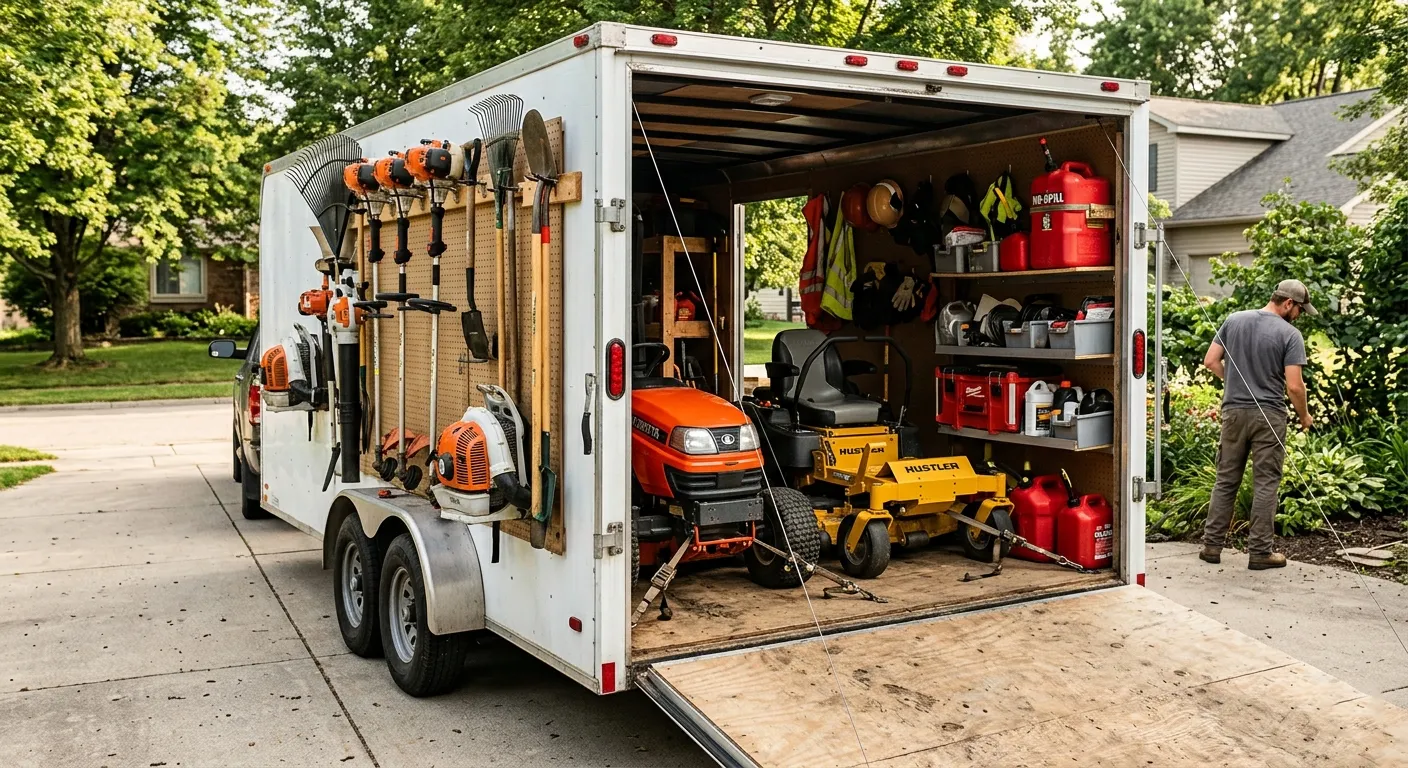
- Enclosed Trailer Setup for Landscaping and Lawn Care
- Enclosed Trailer Setup for Mobile Detailing
- Enclosed Trailer Setup for Contractors and Trades
- Enclosed Trailer Setup for Mobile Service Businesses
- Interior Organization: Shelving, E-Track, Cabinets, and Tie-Downs
- Electrical Packages, Lighting, A/C, Insulation, and Ventilation
- Security for Business Equipment
- Branding: Turning a Trailer Into a Mobile Advertisement
- Maintenance and Pre-Trip Checks
- Budgeting for an Enclosed Trailer as a Startup Asset
- Questions Every Small Business Owner Should Ask Before Buying
- Why Factory-Direct Buying Helps Startup Owners
- Final Takeaway
Why Enclosed Trailers Make Sense for Small Business Startups
A new business often starts with a truck, tools, supplies, and a need to get to customers efficiently. For many trades and service businesses, an enclosed cargo trailer solves several problems at once.
First, it gives the owner secure cargo space. Tools, machines, chemicals, hoses, equipment, parts, and inventory are protected from weather, road debris, sunlight, and casual visibility. That matters for landscapers carrying blowers and trimmers, contractors hauling power tools, detailers carrying vacuums and chemicals, and mobile service businesses carrying job-specific equipment.
Second, an enclosed trailer helps organize daily operations. Instead of loading and unloading a truck bed every morning and evening, the trailer can remain set up with shelving, racks, tie-downs, labeled bins, and dedicated zones. This can save time and reduce the chance of forgetting equipment.
Third, an enclosed trailer can support professional presentation. A clean enclosed trailer with organized doors, proper tie-downs, branded exterior graphics, and a clean setup can make a startup look more established when arriving at a customer’s home or jobsite.
Fourth, it gives the business room to grow. Many owners begin with a basic setup and later add shelving, E-track, lighting, racks, vents, insulation, or electrical packages as the business becomes more specialized.
The First Question: What Will the Trailer Carry Every Day?
Before choosing a trailer size, axle setup, or door style, a business owner should list every item the trailer needs to carry on a normal workday.
A landscaping startup may need space for push mowers, zero-turn mowers, trimmers, blowers, fuel cans, sprayers, rakes, shovels, spare line, oil, gloves, cones, safety gear, and basic repair tools.
A mobile detailing business may need pressure washers, a water tank, generator, air compressor, hoses, reels, towels, chemicals, polishers, vacuums, extension cords, shelving, buckets, and storage for clean and dirty towels.
A contractor may need power tools, ladders, saws, fasteners, cabinets, trim materials, flooring tools, plumbing supplies, electrical parts, jobsite lighting, extension cords, and safety equipment.
A mobile repair or service business may need diagnostic tools, small parts, portable workbenches, batteries, chargers, bins, toolboxes, fluids, specialty machines, and secure storage.
This equipment list should include both size and weight. A trailer that has enough floor space may still be the wrong choice if the total loaded weight exceeds the trailer’s safe payload capacity or the tow vehicle’s limits.
Understanding Trailer Size for Business Use
Trailer size should be selected based on real equipment, not guesswork. Smaller enclosed trailers are easier to tow and store, but they may become limiting as a business grows. Larger trailers provide more space and organization potential, but they require a more capable tow vehicle and more attention to weight, braking, and loading.
A 5x8 or 6x8 enclosed trailer can work well for light mobile services, small tool setups, compact equipment, event supplies, small deliveries, or a single-person startup that wants secure storage without towing a large unit.
A 6x10 or 6x12 enclosed trailer is often a practical middle ground for small businesses. These sizes can work for contractors, mobile detailers, lawn care companies, small delivery businesses, and recreational users who need more floor space without stepping into a much larger trailer.
A 7x14 enclosed trailer is a popular step-up size for businesses that need more usable width, better interior organization, larger shelving systems, bigger equipment, or room to grow.
An 8.5-foot-wide enclosed trailer, such as an 8.5x16, 8.5x20, or 8.5x24, is better suited for larger business setups, multiple machines, motorsports, larger crews, vending support, serious inventory storage, or heavy equipment layouts.
For startups, the smartest approach is to choose the smallest trailer that can safely and comfortably carry today’s equipment while still leaving enough room for near-term growth.

Single Axle vs. Tandem Axle for a Small Business Trailer
Axle setup is one of the most important decisions for a business owner.
A single axle enclosed trailer is often best for lighter loads, local service routes, compact trailer sizes, and owners who want lower upfront cost and easier maneuverability. Single axle trailers are generally easier to move around, easier to park, and lighter to tow. They can be a good fit for light landscaping, mobile detailing, small tool hauling, event supplies, or personal cargo.
A tandem axle enclosed trailer is often better for heavier equipment, longer trailers, frequent business use, highway travel, and owners who want added stability and capacity. Tandem axle trailers distribute weight across two axles, which can improve ride stability and provide more confidence when carrying heavy tools, mowers, water tanks, construction equipment, or dense cargo.
The decision should not be based only on price. Business owners should consider total loaded weight, frequency of use, tow vehicle capacity, route type, resale value, and future growth. If the trailer will be used daily and loaded heavily, tandem axle may be the better long-term investment.
Payload, GVWR, and Towing Capacity: What Startup Owners Must Understand
Every enclosed trailer buyer should understand three basic terms before ordering.
GVWR, or Gross Vehicle Weight Rating, is the maximum total weight the trailer is rated to weigh when loaded. This includes the trailer itself plus cargo.
Empty weight, sometimes called curb weight, is the approximate weight of the trailer before cargo is added.
Payload capacity is the difference between GVWR and empty weight. This is the amount of cargo the trailer can safely carry.
For example, if a trailer has a GVWR of 2,990 pounds and an empty weight of 1,200 pounds, the usable payload is approximately 1,790 pounds before options, cargo placement, and real-world loading are considered.
Business owners should also check the tow vehicle’s towing capacity, hitch rating, tongue weight rating, brake controller requirements, and state trailer brake requirements. A trailer may be strong enough to carry the load, but the tow vehicle must also be properly rated and equipped.
This is especially important for mobile detailing businesses carrying water tanks. Water is heavy. A large water tank can quickly consume payload capacity before tools, hoses, chemicals, generators, and shelving are added.
Ramp Door vs. Barn Doors
Door style depends on how the trailer will be loaded.
A ramp door is often best when rolling equipment into the trailer. Landscapers, detailers, contractors, motorcycle owners, ATV owners, and businesses using carts or wheeled machines usually benefit from a ramp door. It reduces the need for separate ramps and makes loading faster.
Barn doors are often better when cargo is loaded by hand, with a forklift, or in tight spaces where a long ramp may not have room to open. Contractors carrying boxes, bins, materials, and tools may prefer barn doors if they do not roll heavy equipment into the trailer.
Some businesses may benefit from both rear access and a side door. A side door allows the owner to grab tools, chemicals, small parts, or supplies without opening the rear door or unloading equipment.
For many small business startups, the best trailer setup is a rear ramp door plus a side entry door. That combination gives flexibility for equipment loading and quick access during jobs.

Enclosed Trailer Setup for Landscaping and Lawn Care
Landscaping businesses need trailers that can handle daily equipment movement, dirty tools, fuel, grass debris, and fast jobsite access.
A landscaping trailer setup should usually prioritize:
A 6x12 enclosed trailer may work for a small lawn care startup with compact equipment, while a 7x14 or larger trailer may be better for zero-turn mowers, multiple machines, or a crew that carries more tools. Businesses that plan to grow should think beyond the first mower and consider where each future tool will go.
Enclosed Trailer Setup for Mobile Detailing
Mobile detailing businesses have different trailer needs. Their equipment is often dense, specialized, and sensitive to layout. A mobile detailing trailer may carry a water tank, generator, pressure washer, air compressor, vacuums, polishers, hose reels, chemicals, towels, brushes, buckets, extension cords, lighting, and storage bins.
The most important mobile detailing trailer considerations include payload capacity, ventilation, chemical storage, electrical planning, and water management.
A water tank should be positioned carefully to maintain balance. Heavy equipment should be mounted low and secured properly. Shelving should keep chemicals from tipping. Hose reels should be placed where they can be accessed quickly without creating trip hazards. Ventilation is important because detailing trailers can hold fumes, heat, humidity, and chemical odors.
Mobile detailers should also research local rules for wash water, storm drains, chemical runoff, water reclamation, and customer-site washing. In many areas, wash water management is not optional, especially for commercial work. A trailer layout that includes containment mats, water recovery tools, proper storage, and spill supplies may help a detailing business operate more responsibly and professionally.
A 6x12 or 7x14 enclosed trailer is often a practical size for mobile detailing, depending on whether the business carries its own water and power. A smaller trailer may work for rinseless or waterless detailing operations, but a full-service setup with a water tank and generator usually requires more space and payload planning.

Enclosed Trailer Setup for Contractors and Trades
Contractors often use enclosed trailers as mobile tool rooms. Electricians, plumbers, HVAC technicians, remodelers, flooring installers, roofers, painters, and carpenters all benefit from secure, organized cargo space.
A contractor trailer should prioritize tool access, interior shelving, ladder storage, lighting, security, and material organization.
Common contractor upgrades include E-track, shelving, cabinets, workbenches, ladder racks, wall hooks, reinforced flooring, extra height, interior lighting, electrical packages, and side doors.
A contractor should think through the daily workflow. Which tools are used on almost every job? Which tools should be closest to the door? Which items are heavy and should be stored low? Which parts need labeled bins? Which long materials need racks? Where will ladders go? Will the trailer need power for charging batteries?
A well-planned contractor trailer can reduce wasted time, protect expensive tools, and help a small business appear more professional on the jobsite.
Enclosed Trailer Setup for Mobile Service Businesses
Mobile service businesses can include appliance repair, cleaning services, event support, party rentals, mobile vending support, equipment rental, small engine repair, pressure washing, handyman work, pest control, and specialty repair.
These businesses usually need a trailer that balances storage, access, branding, and flexibility.
For mobile service providers, the right enclosed trailer may need:
Unlike recreational trailer buyers, mobile service businesses often use the trailer every day. That means small layout problems become daily frustrations. A startup owner should design the interior around the job process, not just the equipment list.
Interior Organization: Shelving, E-Track, Cabinets, and Tie-Downs
Organization is where a business trailer becomes more than a box on wheels.
Shelving is useful for bins, chemicals, parts, supplies, and small equipment. Cabinets add security and help keep expensive tools out of sight. E-track gives flexible tie-down points for securing cargo, machines, totes, and equipment. Wall hooks and racks keep long tools off the floor. Toolboxes should be placed where they do not overload one side of the trailer.
A good layout usually keeps heavy items low and centered, fast-access items near the side door, fragile items protected from shifting cargo, and dirty or wet items separated from clean supplies.
The trailer should also leave room for movement. A trailer packed wall-to-wall may hold everything, but it may slow the business down if the owner has to unload half the trailer to reach one tool.
Electrical Packages, Lighting, A/C, Insulation, and Ventilation
Electrical options can turn a basic enclosed trailer into a more useful business asset. Interior lights help with early morning loading, late-night work, and enclosed storage. Outlets can support battery charging, tools, vacuums, compressors, or mobile office equipment when properly designed. A generator compartment or shore power setup may be useful for some businesses.
Insulation can help reduce heat transfer, protect temperature-sensitive equipment, and make the trailer more comfortable if someone spends time inside. In hot-weather states like Georgia, Florida, Alabama, South Carolina, North Carolina, Tennessee, and Texas, insulation, roof vents, side vents, white exterior colors, and A/C options may be worth considering.
A/C is not necessary for every business trailer, but it may be valuable for mobile detailing, mobile workshops, event businesses, or trailers used as enclosed workspaces.
Ventilation is especially important when carrying fuel, chemicals, damp equipment, or anything that creates fumes or moisture.
Security for Business Equipment
For a small business, the tools inside the trailer may be worth more than the trailer itself. Security should be part of the buying decision.
Important security considerations include quality coupler locks, door hasps, puck locks, wheel locks, GPS trackers, secure parking habits, motion lighting, cameras, insurance documentation, and inventory photos.
Inside the trailer, tools should be stored in a way that reduces visibility when doors are opened. High-value tools can be kept in lockable cabinets. Serial numbers should be recorded. Business owners should also confirm insurance coverage for tools stored in a trailer, because vehicle insurance, trailer insurance, and inland marine/tool coverage may be separate.
Branding: Turning a Trailer Into a Mobile Advertisement
An enclosed trailer can also function as a rolling billboard. For a startup, this can be valuable because the trailer is seen at customer homes, jobsites, parking lots, and roadsides.
Branding can include the business name, logo, phone number, website, service area, QR code, and a short list of services. The design should be readable from a distance. A clean, professional wrap or vinyl lettering can make a small business look more established.
However, branding also affects security. A trailer that clearly advertises expensive tools may attract attention. Some businesses choose full branding for marketing, while others use more subtle branding to reduce theft risk.
Maintenance and Pre-Trip Checks
A business trailer should be inspected regularly because it becomes part of daily operations. A startup owner should create a simple pre-trip and monthly checklist.
Before each trip, check tire pressure, lights, hitch connection, safety chains, breakaway cable, door latches, load balance, tie-downs, and visible damage.
Monthly or periodically, inspect tires, brakes, bearings, roof seals, flooring, wall panels, wiring, hinges, locks, vents, and undercarriage condition.
For businesses using the trailer every day, maintenance should be scheduled, not guessed. A trailer breakdown can mean missed appointments, unhappy customers, and lost revenue.
Budgeting for an Enclosed Trailer as a Startup Asset
A trailer should be included in the startup budget along with tools, insurance, licenses, marketing, website, branding, fuel, maintenance, and working capital.
The lowest trailer price is not always the lowest business cost. A cheaper trailer that lacks the right axle setup, door style, payload capacity, security, or organization may cost more later through modifications, downtime, repairs, or early replacement.
When comparing trailer options, business owners should consider:
The best trailer for a startup is the one that fits the business plan, not just the cheapest unit available.

Questions Every Small Business Owner Should Ask Before Buying
Before ordering an enclosed trailer, a business owner should answer these questions:
These questions help prevent a buyer from choosing a trailer based only on price or appearance.
Why Factory-Direct Buying Helps Startup Owners
A factory-direct model can help small business owners compare sizes, axle setups, layouts, and available options before ordering or selecting a ready-to-go unit. For entrepreneurs, this is important because the trailer is not just cargo space. It is part of the business system.
Make My Trailer’s factory-direct approach gives buyers the ability to compare enclosed cargo trailers, custom enclosed trailers, stock trailers, and configuration options based on real business needs. Buyers can consider trailer size, door style, axle setup, custom upgrades, pickup preferences, and budget before making a decision.
For startup owners in landscaping, mobile detailing, construction, contracting, and mobile services, that guidance can help avoid common mistakes and create a trailer setup that works from day one.
Final Takeaway
An enclosed trailer can be one of the first major assets a small business owner buys. For some entrepreneurs, it becomes the business’s mobile headquarters. For others, it becomes secure storage, a jobsite tool room, a delivery unit, a mobile detailing base, or a branded advertising platform.
The best trailer is not always the biggest or the cheapest. It is the trailer that matches the work, carries the load safely, protects the equipment, supports daily workflow, and leaves room for growth.
For landscaping businesses, that may mean a ramp door, tie-downs, ventilation, and durable flooring. For mobile detailers, it may mean payload planning, water tank placement, chemical storage, power, ventilation, and shelving. For contractors, it may mean E-track, ladder racks, cabinets, lighting, and extra height. For mobile service businesses, it may mean organization, security, branding, and quick access.
By comparing enclosed trailer sizes, axle setups, door styles, custom options, and towing requirements before buying, small business owners can make a smarter investment and build a trailer setup that helps them operate more professionally from the start.
Ready to build the perfect mobile headquarters for your startup?
Start Your Build with Make My Trailer