
Enclosed Trailer Interior Layouts: How to Organize Shelving, Cabinets, E-Track, Tools, Lighting, Workbenches, and Floor Space
An enclosed trailer is more than an empty cargo box. For many owners, it becomes a mobile workshop, jobsite storage room, equipment hauler, landscaping trailer, mobile mechanic station, event trailer, or secure cargo unit on wheels. The outside of the trailer matters, of course. Buyers need to compare size, axle setup, door style, payload, towing capacity, and price. But once the trailer is in daily use, the interior layout often determines whether the trailer feels efficient or frustrating.
A well-planned enclosed trailer interior can save time, protect equipment, improve loading and unloading, reduce clutter, and help owners use every inch of available space without making the trailer harder to work from. A poorly planned layout, on the other hand, can create blocked aisles, buried tools, unstable weight distribution, hard-to-reach tie-downs, and wasted floor space.
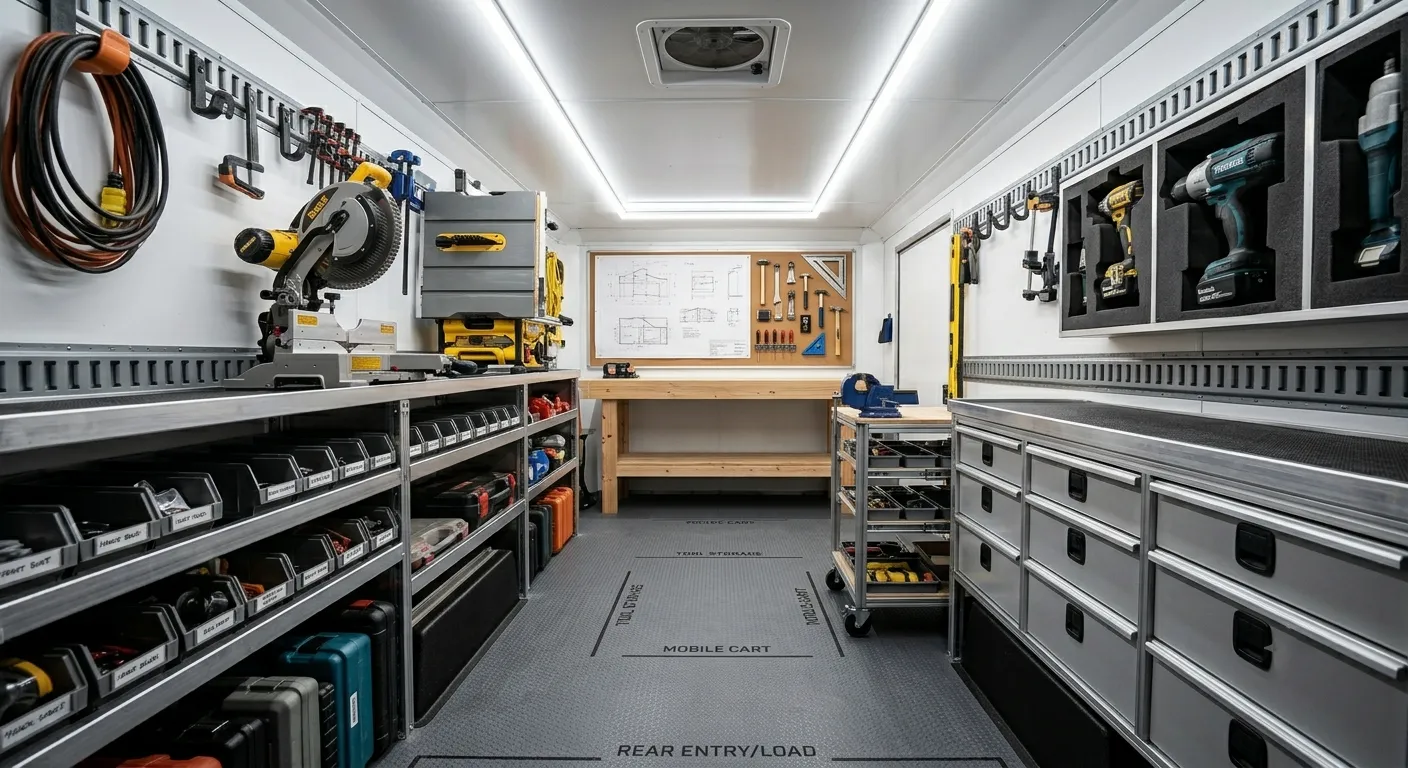
This guide explains how to think through enclosed trailer organization before buying, building, or customizing a trailer. It covers shelving, cabinets, E-track, wall hooks, tool racks, spare tire placement, interior lighting, workbenches, open floor planning, weight balance, and layout ideas for contractors, landscapers, mobile mechanics, event companies, mobile service businesses, recreational users, and general cargo buyers.
- Why Enclosed Trailer Interior Layout Matters
- Start With Zones, Not Accessories
- Plan Around Weight Before Storage
- Shelving Layouts for Enclosed Trailers
- Cabinets for Secure and Professional Storage
- E-Track and Tie-Down Systems
- D-Rings vs E-Track: Which Is Better?
- Wall Hooks, Cord Holders, and Tool Racks
- Spare Tire Placement
- Interior Lighting for Better Trailer Function
- Workbenches for Mobile Mechanics and Service Businesses
- Protecting Open Floor Space
- Contractor Trailer Layout Ideas
- Landscaping Trailer Layout Ideas
- Mobile Mechanic Trailer Layout Ideas
- Event Company Trailer Layout Ideas
- Mobile Detailing and Cleaning Trailer Layout Ideas
- Motorcycle, ATV, and Powersports Layout Ideas
- General Cargo and Moving Layout Ideas
- Floor Protection and Surface Planning
- Ventilation and Airflow
- How to Plan an Enclosed Trailer Interior Step by Step
- Questions to Ask Before Customizing an Enclosed Trailer Interior
- Common Enclosed Trailer Layout Mistakes
- The Best Enclosed Trailer Layout Is the One Built Around Your Use
- Final Thoughts
Why Enclosed Trailer Interior Layout Matters
Many buyers start by asking, “What size enclosed trailer do I need?” That is the right first question, but it should not be the only one. A 6x12, 7x14, 8.5x16, or 8.5x20 trailer can feel much larger or much smaller depending on how the inside is organized.
The best enclosed trailer interior layout should answer four practical questions:
A contractor may need shelving for tools, fasteners, drill cases, saws, levels, extension cords, and jobsite supplies. A landscaper may need more open floor room for mowers, blowers, trimmers, fuel cans, ramps, and spare parts. A mobile mechanic may need secure drawers, a workbench, lighting, battery charging, parts bins, and quick access to hand tools. An event company may need room for bins, tents, tables, décor, sound equipment, and rolling carts.
That is why the right layout is not the same for every buyer. The best enclosed trailer organization plan starts with the actual cargo, the weight of that cargo, and the order in which items need to be loaded or removed.

Start With Zones, Not Accessories
One of the most common mistakes buyers make is choosing accessories before planning the layout. Shelving, cabinets, hooks, racks, E-track, and workbenches are useful, but only if they support the trailer’s real purpose.
A better approach is to divide the interior into zones:
When a trailer is planned this way, every shelf, cabinet, rack, hook, or E-track rail has a purpose. The trailer becomes easier to load, safer to tow, and more useful every day.
Plan Around Weight Before Storage
Interior organization is not just about neatness. It also affects how the trailer tows.
Heavy items should generally stay low, secured, and balanced. Avoid stacking heavy tools or materials high on the walls unless the trailer structure and mounting points are designed for it. High-mounted weight can raise the center of gravity, making the trailer feel less stable. Uneven side-to-side loading can also overload one tire, one spring, or one side of the trailer.
A good rule for layout planning is to put the heaviest items on or near the floor, close to the axle area, while still maintaining proper tongue weight. Large toolboxes, compressors, generators, water tanks, heavy bins, spare parts, and equipment should be placed before lighter shelves and wall accessories are finalized.
For business trailers, owners should think about the trailer when it is fully loaded, not when it is empty. A trailer may look clean and organized in the shop, but if the heaviest tools end up on one wall, the mower blocks access to the cabinets, and the spare tire is buried behind cargo, the layout will not work in real daily use.
Shelving Layouts for Enclosed Trailers
Shelving is one of the most useful upgrades for an enclosed trailer, especially for contractors, mobile service businesses, event companies, and general cargo owners. Shelves keep smaller items off the floor and reduce the need to stack loose boxes or tool cases.
A good shelving layout should be strong, shallow enough to avoid stealing too much floor width, and designed around the items being stored. Deep shelves can hold more, but they also create two problems: items get buried in the back, and the shelf intrudes into the walkway. For many enclosed trailers, narrow wall shelving with lips, bins, or doors works better than deep open shelves.
Popular shelving ideas include:
Shelving should not block side doors, vents, electrical panels, tie-down points, or spare tire access. It should also be mounted into strong structural points, not just thin wall panels. If the trailer will carry heavy inventory or tools, the buyer should ask about wall studs, interior wall material, and mounting support before installing shelves.
Cabinets for Secure and Professional Storage
Cabinets make sense when the trailer carries expensive tools, small equipment, paperwork, chemicals, replacement parts, or items that should not roll around during transport. Compared with open shelving, cabinets look cleaner and provide better protection from dust, vibration, and shifting cargo.
For contractors, cabinets can hold blades, drill bits, safety glasses, screws, anchors, batteries, hand tools, and measuring tools. For mobile mechanics, cabinets can organize sockets, fluids, diagnostic equipment, parts, filters, and specialty tools. For event companies, cabinets can protect cables, tablets, controllers, microphones, décor items, and smaller equipment that needs to stay organized.
When choosing cabinets, consider:
A front cabinet is often a good choice because it uses space that may otherwise be underutilized. However, placing too much heavy storage at the front of the trailer can affect tongue weight, so the final layout should still be checked against the trailer’s payload and towing requirements.
E-Track and Tie-Down Systems
E-track is one of the most flexible enclosed trailer organization upgrades because it can support both cargo securement and storage accessories. It gives owners adjustable anchor points instead of relying only on fixed D-rings.
Wall-mounted E-track is useful for securing tall cargo, hanging accessories, organizing straps, and attaching hooks or baskets. Floor-mounted E-track is helpful for motorcycles, carts, rolling equipment, appliances, toolboxes, and cargo that changes from trip to trip. Vertical E-track can help with shelving and adjustable storage.
Common E-track uses include:
Before installing E-track, measure the trailer and map out where cargo will actually sit. Think about the doors, wheel wells, side access, shelving, and open floor path. E-track should be mounted with proper hardware into appropriate support points, and every strap, ring, hook, or accessory should be used within its rated working load limit.
D-Rings vs E-Track: Which Is Better?
D-rings and E-track both have a place in enclosed trailer layouts.
D-rings are simple, strong, and useful for fixed tie-down locations. They are common for motorcycles, mowers, ATVs, and cargo that usually sits in the same place. Floor D-rings are especially useful when the owner knows exactly where the load will go every time.
E-track is more flexible. It gives the owner multiple tie-down positions and supports accessories such as hooks, baskets, spare tire holders, and shelving systems. For business owners whose cargo changes from day to day, E-track can be more useful than fixed tie-downs alone.
Many of the best enclosed trailer setups use both. D-rings handle primary fixed loads, while E-track provides flexible cargo control and organization.

Wall Hooks, Cord Holders, and Tool Racks
Wall hooks are one of the easiest ways to improve trailer organization, but they should be used thoughtfully. A wall full of hooks can quickly become cluttered if there is no system.
Hooks work well for:
Tool racks are especially important for landscapers and contractors. A trimmer rack, blower rack, shovel rack, or ladder rack can prevent equipment from bouncing around on the floor. It also speeds up unloading because workers know exactly where every tool belongs.
For safety, hooks and racks should hold items tightly enough that they do not fall during towing. Long-handled tools should not swing into the walkway. Cords and hoses should be coiled cleanly so they do not become trip hazards. Anything mounted to the wall should be checked periodically for loose fasteners, cracked brackets, or vibration damage.
Spare Tire Placement
The spare tire should never be an afterthought. It is easy to mount a spare wherever there is empty space, but the real test happens on the side of the road when the trailer is fully loaded.
A good spare tire location should be:
Common spare tire locations include the front interior wall, a side wall mount, the tongue, or an exterior mount, depending on the trailer design and the buyer’s preference. For business trailers, the spare should be stored with the jack, lug wrench, wheel chocks, and any adapter needed to change a tire.
If the trailer is used for long trips, jobsite work, or daily business operations, the spare tire setup should be treated as part of the layout, not just an accessory.
Interior Lighting for Better Trailer Function
Lighting is one of the most overlooked enclosed trailer upgrades. A trailer may be easy to use in daylight, but difficult to work from early in the morning, after dark, inside a shop, or at a dim jobsite.
Good lighting improves:
LED ceiling lights are popular because they are efficient and bright. Strip lights can help illuminate shelves or cabinets. Task lights can be placed above a workbench. Exterior loading lights can help with ramp visibility at night.
For trailers used as mobile workspaces, lighting should be planned before cabinets and shelving are finalized. Shelves can cast shadows, tall equipment can block light, and a workbench may need dedicated task lighting. If the trailer will include electrical outlets, battery charging, an inverter, or shore power, the electrical package should be discussed early in the buying or customization process.
Workbenches for Mobile Mechanics and Service Businesses
A workbench can turn an enclosed trailer into a mobile workspace. Mobile mechanics, contractors, repair technicians, race teams, detailers, and service businesses often benefit from having a small bench inside the trailer.
A good trailer workbench should be:
A front workbench can work well in many trailers because it uses the nose or front wall area, but it can also make the trailer tongue-heavy if combined with heavy cabinets, batteries, compressors, or parts storage. A fold-down workbench may be better when open floor space is limited. A side-wall workbench can be practical for mobile mechanics, but it should not reduce the aisle so much that rolling equipment becomes difficult to move.
For mobile mechanics, a good setup may include a bench, vice mount, parts drawers, overhead lighting, battery charger, air hose reel, and secure cabinet storage. For contractors, the bench may be used for cutting, measuring, sorting fasteners, or charging tools.
Protecting Open Floor Space
The biggest mistake in trailer organization is filling every wall and every corner with storage. Storage is valuable, but open floor space is what lets the trailer function.
Open floor space is needed for:
A good layout leaves a center path or loading lane. Even if both walls have shelves, the floor should still allow the owner to step inside, reach cargo, attach straps, and unload equipment without climbing over everything.
Before adding shelves or cabinets, measure the widest item that will enter the trailer. Then measure the door opening, wheel-well clearance, interior width, and turning room. If a mower, motorcycle, cart, or dolly needs to roll in and out, the layout should protect that path.

Contractor Trailer Layout Ideas
Contractors need fast access to tools and materials. A contractor trailer should be organized around daily workflow: grab tools, load materials, go to the job, unload, work, and return everything to the correct place.
A strong contractor layout may include:
Electricians may need shelves for wire, connectors, boxes, and testers. Plumbers may need pipe storage, parts bins, and secure tool cabinets. Remodelers may need space for saws, compressors, vacuums, and materials. HVAC technicians may need room for equipment, tanks, fittings, and service tools.
The best contractor trailer layout keeps frequently used tools closest to the side door or rear entry, while less-used items can go higher or farther forward.
Landscaping Trailer Layout Ideas
A landscaping trailer has a different job. It usually needs to carry machines, fuel, handheld tools, and maintenance supplies. Because mowers and equipment often take up most of the floor, the walls become valuable storage areas.
A landscaping layout may include:
The key for landscapers is not overbuilding the floor area. Mowers need a clean path. The ramp area should stay clear. Tall racks should be placed where they do not interfere with equipment handles, side doors, or the operator’s movement.
Mobile Mechanic Trailer Layout Ideas
Mobile mechanics need a trailer that feels like a service bay on wheels. Organization matters because searching for tools wastes time, and loose parts can create safety problems.
A mobile mechanic layout may include:
Mobile mechanics should avoid placing too much weight high or on one side. Tool chests, parts, compressors, and fluids can become heavy very quickly. The trailer should be laid out so the heaviest items are low and secure.
Event Company Trailer Layout Ideas
Event companies often haul items that are bulky but not always extremely heavy: tables, chairs, tents, linens, décor, signs, cables, lighting, speakers, backdrops, trade show displays, and storage bins.
A good event trailer layout may include:
Event trailers should be planned around unloading speed. The first items needed at the venue should be easiest to access. Items that come out last can go deeper inside. Labeling shelves and bins can save major time when crews are working under pressure.
Mobile Detailing and Cleaning Trailer Layout Ideas
Mobile detailing and cleaning businesses need to carry water tanks, pressure washers, generators, hoses, chemicals, towels, vacuums, polishers, and supplies. This creates a unique layout challenge because some items are heavy, some need ventilation, and some must stay separated.
A good detailing or cleaning layout may include:
For any trailer carrying liquids, weight planning is critical. Water is heavy. A tank location should be chosen carefully so the trailer remains balanced when the tank is full, partially full, or empty.
Motorcycle, ATV, and Powersports Layout Ideas
Recreational buyers often use enclosed trailers to protect motorcycles, dirt bikes, ATVs, UTVs, golf carts, or gear. These layouts should focus on floor space, tie-down points, wheel chocks, and easy loading.
A powersports layout may include:
The most important part is measuring the machine before choosing a layout. Length, width, handlebar clearance, roof height, ramp angle, and tie-down angle all matter. A layout that works for one motorcycle may not work for a side-by-side or multiple bikes.
General Cargo and Moving Layout Ideas
For buyers who use the trailer for general cargo, moving, seasonal storage, or household projects, flexibility matters more than a specialized setup.
A general-purpose layout may include:
A simple layout may be better than a fully built-out layout for general cargo buyers. Too many permanent shelves can reduce the trailer’s ability to carry large items later.
Floor Protection and Surface Planning
The trailer floor takes a lot of abuse. Tools are dropped, machines roll in, fuel can spill, tires track mud, and cargo slides during loading. The floor surface should match the trailer’s use.
Common floor choices include plywood, rubber mats, coin flooring, aluminum tread plate, epoxy coating, or reinforced flooring. Contractors and landscapers may prioritize durability. Detailers may prioritize moisture protection. Powersports buyers may want traction and easy cleanup. Event companies may need a floor that protects bins and rolling cases.
Whatever surface is used, the owner should still keep tie-down access clear and inspect the floor periodically for moisture damage, soft spots, loose fasteners, or worn areas near the ramp and doorway.
Ventilation and Airflow
Ventilation is important for enclosed trailers, especially in hot climates or when the trailer carries fuel-powered equipment, chemicals, tools, batteries, or supplies affected by heat. Roof vents and side vents can help reduce heat buildup and moisture. For mobile workspaces, ventilation can make the trailer more usable during daily work.
Ventilation should be planned with shelving and cabinets in mind. Do not block vents with storage. If the trailer carries fuel cans, machines, generators, or chemical products, follow the manufacturer’s safety instructions and avoid running engines or generators inside an enclosed cargo trailer.

How to Plan an Enclosed Trailer Interior Step by Step
The best enclosed trailer organization plan starts on paper before anything is mounted.
Questions to Ask Before Customizing an Enclosed Trailer Interior
Before ordering or customizing an enclosed trailer, buyers should ask:
These questions help buyers think beyond the empty trailer and focus on how the trailer will work after it is loaded.
Common Enclosed Trailer Layout Mistakes
Avoid these common mistakes:
A good trailer layout should make daily work easier, not just look organized in photos.
The Best Enclosed Trailer Layout Is the One Built Around Your Use
There is no single “best” enclosed trailer shelving layout for every buyer. The right interior depends on the trailer size, cargo type, weight, work habits, loading method, and how often the owner needs access to specific tools or equipment.
For contractors, the best layout may be shelves, cabinets, hooks, and a small workbench. For landscapers, it may be open floor space, trimmer racks, blower racks, and fuel storage. For mobile mechanics, it may be cabinets, drawers, task lighting, and a secure workbench. For event companies, it may be labeled bins, E-track, rolling cart space, and protected electronics storage. For general cargo buyers, it may be a simple flexible layout with E-track, hooks, and open space.
The main goal is to make the trailer safer, cleaner, easier to load, and more efficient to use.
Final Thoughts
An enclosed trailer interior should be planned before the trailer is fully built, customized, or loaded for daily work. Shelving, cabinets, E-track, wall hooks, tool racks, lighting, spare tire placement, workbenches, and open floor space all affect how useful the trailer becomes.
A well-planned enclosed trailer can function as a mobile workshop, organized storage unit, jobsite support vehicle, event trailer, landscaping trailer, motorcycle hauler, or general cargo solution. The best results come from planning the layout around real cargo, real workflow, safe loading, and long-term use.
Make My Trailer helps buyers compare enclosed trailer sizes, axle setups, ramp door and barn door options, interior upgrades, storage solutions, and factory-direct trailer configurations. For buyers who want a trailer that works better from day one, interior layout planning is one of the smartest steps to take before placing an order.
Ready to design the perfect interior layout for your workflow?
Start Your Custom Build at Make My Trailer