

Enclosed Trailer Customization Guide for Contractors: How to Build a Work-Ready Trailer for Tools, Materials, and Jobsite Efficiency
For contractors, an enclosed trailer is not just a way to move equipment from one place to another. When it is planned correctly, it becomes a mobile tool room, material hauler, secure storage unit, jobsite support station, and business asset. The right enclosed trailer setup can help electricians, plumbers, remodelers, roofers, flooring installers, HVAC technicians, landscapers, and construction crews stay organized, protect expensive tools, and move between jobs more efficiently.
A poorly planned contractor trailer can create daily frustration. Tools get buried. Extension cords tangle. Materials slide around. Ladders take up floor space. Heavy equipment becomes difficult to load. The trailer may be too small, too low, underbuilt, or missing the door style that fits the work. That is why enclosed trailer customization should start with one question: how will the trailer be used every day?
Make My Trailer’s contractor customization guide focuses on helping trade professionals compare enclosed trailer sizes, axle setups, door styles, flooring, wall protection, shelving, tie-downs, ventilation, ladder racks, lighting, and job-specific upgrades before buying. A contractor who thinks through the build first is more likely to end up with a trailer that works like part of the crew instead of just another piece of equipment.
- Why Contractors Choose Enclosed Trailers
- Start With the Trade, Not the Trailer Size
- Choosing the Right Enclosed Trailer Size for Contractors
- Single Axle vs. Tandem Axle for Contractor Trailers
- Ramp Door vs. Barn Doors for Contractor Use
- Interior Organization: The Heart of a Contractor Trailer
- Flooring and Wall Protection
- Ventilation, Insulation, and Climate-Related Upgrades
- Exterior Upgrades That Improve Daily Use
- Security Considerations for Contractor Trailers
- Trade-Specific Enclosed Trailer Setup Ideas
- Weight, Payload, and Safe Loading
- Contractor Trailer Buying Checklist
- Maintenance for Contractor Enclosed Trailers
- Factory-Direct Contractor Trailer Builds in Georgia
Why Contractors Choose Enclosed Trailers
Contractors use enclosed trailers because they solve several jobsite problems at once. An enclosed cargo trailer gives tools and materials a lockable, weather-protected space. Compared with an open trailer, it protects equipment from rain, sun, wind, road debris, and casual visibility. For business owners carrying expensive tools, parts, or machines, that protection matters.
An enclosed trailer also helps create a more professional work system. Instead of unloading and reloading a truck bed every day, contractors can keep frequently used tools, consumables, fasteners, parts, and safety gear in assigned locations. A well-organized trailer can reduce time spent searching for tools, making emergency supply runs, or repacking between jobs.
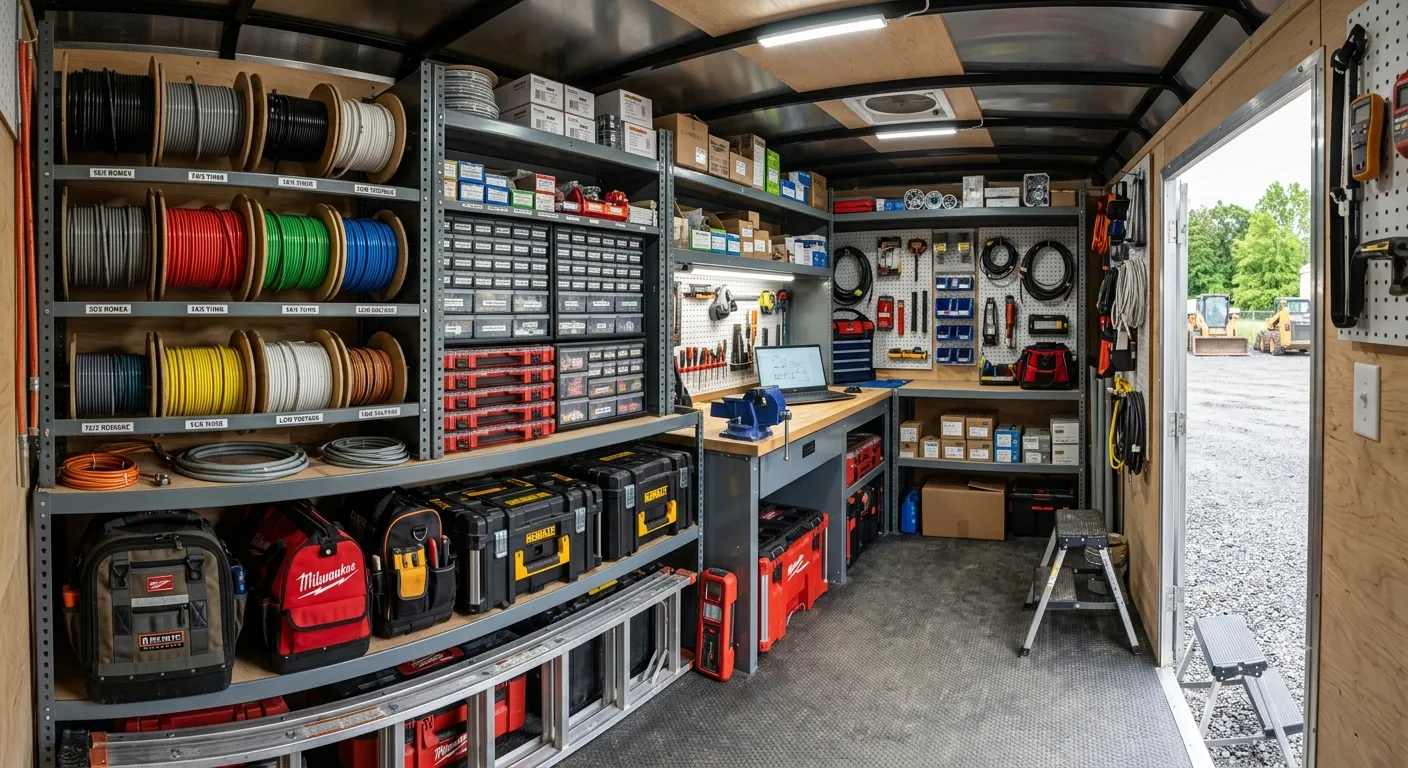
For many trades, the trailer becomes a rolling shop. Contractors can set up shelves, cabinets, bins, wall racks, E-track, D-rings, work lighting, and tool storage to match their workflow. The best setup is not always the most expensive setup. It is the setup that saves time, protects equipment, and matches the weight, size, and frequency of the work.

Start With the Trade, Not the Trailer Size
One of the biggest mistakes buyers make is starting with a trailer size before thinking through their work. A 6x12, 7x14, or 8.5x20 enclosed trailer can all be useful, but the right choice depends on the trade, equipment, materials, and tow vehicle.
A solo electrician may need a compact trailer with bins, shelves, wire storage, and secure tool cabinets. A remodeling crew may need a larger trailer with open floor space, wall protection, and room for saws, job boxes, ladders, trim, tile, and demolition tools. A roofer may need roof-mounted ladder racks, ramp access, durable flooring, and room for compressors, nailers, tear-off tools, and bulky materials. An HVAC contractor may need organized storage for fittings, parts, tools, refrigerant handling equipment, ladders, and replacement components.
The best contractor trailer begins with a realistic inventory:
Answering these questions first helps buyers avoid underbuying, overbuying, or choosing the wrong layout.
Choosing the Right Enclosed Trailer Size for Contractors
Trailer size should be based on current work needs and near-future growth. Contractors often buy too small because they are trying to keep the price low. That can work for very light-duty tool hauling, but it can become a problem once shelving, job boxes, ladders, spare parts, and materials are added.
A 5x8 or 6x10 enclosed trailer can work well for light service work, small tool loads, mobile repair, or weekend jobs.
A 6x12 is one of the most practical mid-size choices because it gives more floor space while staying manageable for many buyers.
A 7x14 can be a strong fit for contractors who need more width, better interior movement, and room for heavier equipment.
Larger 8.5-foot-wide trailers, such as 8.5x16, 8.5x20, or 8.5x24, are better suited for crews, larger equipment, multiple tool stations, or businesses that want a true mobile workshop.
When comparing sizes, contractors should think beyond the empty box. Shelving reduces interior width. Cabinets use wall and floor space. E-track and tool racks need mounting areas. Ladders, pipe, trim, flooring, ductwork, and long materials may require extra length. Mowers, compressors, generators, floor grinders, saws, and carts may require ramp access and clear floor space.
It is often better to choose a trailer that leaves room for organized growth instead of one that is full on day one.
Single Axle vs. Tandem Axle for Contractor Trailers
Axle setup is one of the most important contractor trailer decisions.
A single axle enclosed trailer is usually lighter, simpler, easier to maneuver, and more affordable. It can be a strong choice for smaller service contractors, lighter tool loads, parts storage, motorcycles, small equipment, or compact mobile business setups.
A tandem axle trailer is often better for heavier tools, larger crews, frequent highway travel, and contractors who carry materials in addition to tools. Tandem axles typically provide better stability, more load capacity, and improved road manners under heavier loads. They can also be more forgiving when the trailer is used daily or loaded near its upper range.
Contractors should not choose axle setup by trailer length alone. They should compare the trailer’s empty weight, GVWR, payload capacity, axle rating, expected cargo weight, and tow vehicle rating. A trailer used for ladders and light hand tools has very different needs than one used for tile, roofing materials, flooring equipment, compressors, water heaters, generators, or heavy jobsite machines.
Ramp Door vs. Barn Doors for Contractor Use
Door style affects daily productivity.
A ramp door is ideal when rolling equipment in and out of the trailer. Contractors who use dollies, carts, mowers, floor machines, compressors, pressure washers, generators, or motorcycles often benefit from a ramp door. Ramp doors also make it easier to load heavy items without lifting them into the trailer.
Barn doors are often better for contractors who load by hand, work in tight spaces, or need fast access to tools and materials. Barn doors do not require the rear clearance needed to lower a ramp, which can be helpful in driveways, alleys, warehouses, and crowded jobsites. They can also be convenient when loading lumber, boxes, bins, tools, and smaller materials.
Some contractors prefer ramp doors because their work changes from job to job. Others prefer barn doors because they access the rear of the trailer many times per day and do not want to drop a ramp each time. The right choice depends on loading method, jobsite space, equipment weight, and how often the trailer is opened.

Interior Organization: The Heart of a Contractor Trailer
A contractor trailer should be organized around workflow. The goal is to give every tool and material a predictable place. Organization reduces wasted time, prevents damage, and makes it easier to know when supplies need to be restocked.
Shelving is useful for bins, parts, fasteners, fittings, adhesives, boxes, and small tools. Cabinets work well for expensive tools, batteries, chargers, test equipment, and items that should stay out of sight. Wall racks are useful for shovels, brooms, levels, extension cords, hoses, and long-handled tools. E-track and D-rings help secure cargo and keep heavy items from shifting during transport. Job boxes add theft-resistant storage for high-value tools.
The best layout usually keeps heavy items low and forward, frequently used tools near the side door or rear opening, and long materials along the wall or roof rack. Aisles should remain open enough for safe movement and quick access. If a trailer is so packed that workers have to climb over tools to reach parts, the layout needs to be redesigned.
Flooring and Wall Protection
Contractor trailers take more abuse than recreational trailers. Heavy tools, sharp materials, muddy equipment, adhesives, oils, fasteners, and jobsite debris can wear down floors and walls quickly.
Durable flooring matters. Treated plywood flooring is common, but contractors may also consider upgraded flooring, rubber coin flooring, heavy-duty mats, or protective coatings depending on the work. Flooring installers, remodelers, roofers, plumbers, and construction crews should think carefully about how the trailer floor will handle sharp edges, rolling loads, moisture, and repeated loading.
Wall protection is just as important. Interior plywood walls may be enough for lighter use, but contractors carrying tools, pipe, ladders, carts, or bulky materials may benefit from reinforced wall panels, kick plates, or wall-mounted storage systems. Good wall protection keeps the trailer from getting beat up and gives racks, shelves, and E-track a stronger foundation.
Ventilation, Insulation, and Climate-Related Upgrades
Ventilation is often overlooked, but it can matter for contractors who store chemicals, adhesives, wet tools, fuel containers, or temperature-sensitive materials. Roof vents and side vents can help reduce heat and moisture buildup. Ventilation can also make the trailer more comfortable when workers spend time inside organizing tools or loading equipment.
Insulation is useful for contractors who store materials affected by temperature swings or who use the trailer as a mobile workspace. HVAC technicians, mobile service providers, flooring installers, and detailers may benefit from insulation depending on what they carry. Air conditioning may be useful for specialty builds where the trailer functions as a workspace, mobile office, or equipment support unit.
Contractors using generators must think carefully about safety. Portable generators should not be operated inside enclosed trailers. If a generator is part of the business setup, it should be used outdoors with proper ventilation, clearance, and safety practices. A trailer can store a generator, but it should not become an enclosed operating space for combustion equipment.

Exterior Upgrades That Improve Daily Use
Exterior upgrades can make a contractor trailer much more practical. Ladder racks are one of the most valuable upgrades for roofers, electricians, plumbers, HVAC technicians, painters, remodelers, and flooring installers. Keeping ladders on the roof frees interior space and makes access faster.
Exterior lighting can help with early morning, evening, or low-light jobsites. Awnings may be useful for mobile service businesses or contractors who need shade and weather protection while working around the trailer. Extra height can be valuable for taller equipment, better headroom, and improved interior workflow. Blackout packages, upgraded wheels, and custom colors can improve brand presentation, especially for contractors who want a cleaner, more professional appearance.
A contractor trailer is often seen by customers, homeowners, builders, and other trades. A clean, organized, branded trailer can help communicate professionalism before the contractor even starts the job.
Security Considerations for Contractor Trailers
Tools are expensive, and theft can stop a job immediately. Contractors should think about trailer security before purchasing and before setting up the interior.
A lockable enclosed trailer already provides more protection than an open trailer, but additional security upgrades may be worth considering. These can include stronger coupler locks, wheel locks, upgraded door latches, puck locks, alarm systems, GPS tracking, interior lock boxes, and secure storage for high-value tools.
Interior organization also affects security. Expensive tools should not be visible from outside. High-value items should be locked inside cabinets or job boxes when possible. Contractors should also consider where the trailer will be parked overnight, whether it will remain loaded, and how often it will be left unattended at jobsites.
Trade-Specific Enclosed Trailer Setup Ideas
Electricians
Electricians usually need organized small-parts storage. Bins for wire nuts, outlets, breakers, fittings, plates, connectors, and fasteners can save time every day. Shelving, labeled containers, spool storage, ladder racks, battery charging stations, interior lighting, and secure tool cabinets are useful upgrades. E-track or tie-down points can help secure ladders, job boxes, and larger equipment.
A side door is especially helpful for electricians because many service calls require quick access to parts and tools without opening the rear of the trailer.
Plumbers
Plumbers need space for pipe, fittings, drain machines, water heaters, toolboxes, pumps, and repair equipment. Long material storage is important. So is durable flooring, because plumbing work often involves wet tools, heavy machines, and dirty jobsite conditions.
A plumber’s trailer may benefit from shelving on one side, pipe or long-part storage on the other, and clear floor space for machines. Ramp access can help with drain machines, water heaters, and heavier equipment.
Remodelers and General Contractors
Remodelers need flexibility. Their trailer may carry saws, stands, compressors, nailers, demolition tools, trim, tile, drywall tools, flooring materials, fasteners, and job boxes. A remodeler’s trailer should not be too specialized unless the business focuses on one type of work.
A good remodeler setup includes wall protection, flexible tie-downs, open floor space, strong shelving, secure tool storage, and a layout that can change from project to project. A tandem axle setup may make sense for crews that carry heavier tools and materials frequently.
Roofers
Roofers often need ladder racks, durable flooring, ventilation, and open interior space. Roofing work can involve compressors, nail guns, tear-off tools, safety gear, tarps, generators, and bulky materials. Ramp doors can make loading equipment easier, while ladder racks keep long ladders outside the cargo area.
Roofers should be especially careful with payload planning. Roofing materials and debris can become heavy quickly, and an enclosed trailer should be matched properly to the load and tow vehicle.
Flooring Installers
Flooring installers need length, tie-downs, and careful planning for long materials. Flooring trailers may carry planks, rolls, adhesives, underlayment, saws, cutters, grinders, vacuums, and installation tools. Interior wall protection and floor protection are important because flooring tools and materials can be heavy, sharp, or messy.
A ramp door can be useful for rolling carts and machines. Interior organization should separate adhesives, tools, and flooring materials to prevent damage and spills.
HVAC Technicians
HVAC trailers need shelves, bins, ladder racks, parts storage, and room for tools, duct components, refrigerant-related equipment, and replacement parts. A side door can help with quick access to common parts. Interior lighting is valuable for early service calls and late-day work.
HVAC contractors should consider ventilation, especially if the trailer carries materials or equipment affected by heat. Secure storage for gauges, meters, batteries, and specialty tools is also important.
Construction Crews
Construction crews need heavy-duty layouts. A larger enclosed trailer with tandem axles, wall protection, tie-downs, open floor space, and durable flooring may be the right choice. Crews often carry a changing mix of tools and materials, so flexibility matters more than a highly specialized layout.
A construction crew trailer should be easy to load, easy to inventory, and strong enough for daily use.

Weight, Payload, and Safe Loading
Every contractor trailer setup should account for weight. Shelving, cabinets, toolboxes, generators, compressors, spare parts, ladders, and materials all add up. Contractors should understand the difference between empty trailer weight, GVWR, axle rating, and payload capacity.
Payload is the amount of cargo a trailer can carry after subtracting the empty trailer weight from the GVWR. A trailer can run out of payload before it runs out of physical space, especially when carrying dense materials such as tile, flooring, roofing supplies, pipe, water heaters, concrete tools, or heavy machines.
Cargo should be loaded so the trailer remains stable. Heavy items should be secured, and cargo should not be allowed to shift while driving. Tie-downs, E-track, D-rings, wheel chocks, and cargo bars can help keep the load stable. Contractors should also make sure the tow vehicle, hitch, ball mount, tires, and brakes are properly rated for the loaded trailer.
Contractor Trailer Buying Checklist
Before ordering a contractor enclosed trailer, buyers should ask:
This checklist helps contractors avoid buying based only on price. The cheapest trailer is not always the best value if it is too small, underbuilt, hard to load, or missing the features needed for daily work.
Maintenance for Contractor Enclosed Trailers
Contractor trailers work hard, so maintenance should be part of the ownership plan. Owners should check tires, lights, brakes, breakaway system, hitch components, safety chains, door hardware, roof seals, flooring, wall panels, vents, and tie-down points regularly.
Tires should be inspected for pressure, tread, age, damage, and proper load rating. Wheel bearings should be serviced according to the manufacturer’s recommendations. Roof seams and vents should be inspected for leaks. Doors, hinges, latches, and locks should be kept in good working condition. Interior shelving and tie-downs should be checked because constant vibration can loosen hardware over time.
A contractor trailer that is organized and maintained will last longer, protect tools better, and create fewer jobsite delays.
Factory-Direct Contractor Trailer Builds in Georgia
For contractors comparing enclosed trailer options, factory-direct buying can make the process easier to understand. Instead of choosing only from generic lot inventory, buyers can compare trailer sizes, axle setups, door styles, and custom options based on their actual trade.
Make My Trailer supports contractors, tradespeople, small business owners, and construction crews with enclosed cargo trailers, stock trailer availability, Georgia pickup, and custom build options. Buyers can compare practical configurations for tools, materials, jobsite use, and mobile business needs before placing an order.
For a contractor, the right enclosed trailer is not just cargo space. It is a mobile system for protecting tools, saving time, improving organization, and showing up to the jobsite prepared. A well-planned trailer can support the way a contractor works today while leaving room for the business to grow tomorrow.
Ready to build the ultimate rolling workspace for your crew?
Customize Your Trailer at Make My Trailer