
Complete Enclosed Trailer Setup Guide for Motorcycle, ATV, and UTV Owners
For motorcycle, ATV, and UTV owners, an enclosed trailer is not just a box on wheels. It is a mobile garage, gear room, storage unit, weather shield, security upgrade, and loading system all in one. The right enclosed trailer setup can make every ride, trail trip, race weekend, hunting trip, farm run, or family powersports outing easier and safer. The wrong setup can create loading problems, tie-down issues, weight problems, clearance problems, and expensive frustration.
Many recreational buyers begin with simple questions like: “What is the best enclosed trailer for motorcycles?” or “What size trailer do I need for a UTV?” The real answer depends on what you haul, how often you haul it, how much room you need around the machine, and whether the trailer is set up correctly from the beginning.
This guide explains how motorcycle, ATV, and UTV owners should think about enclosed trailer size, ramp doors, D-rings, E-track, wheel chocks, floor strength, interior height, trailer width, ventilation, tie-down placement, payload capacity, and smart interior organization before buying or customizing a trailer.
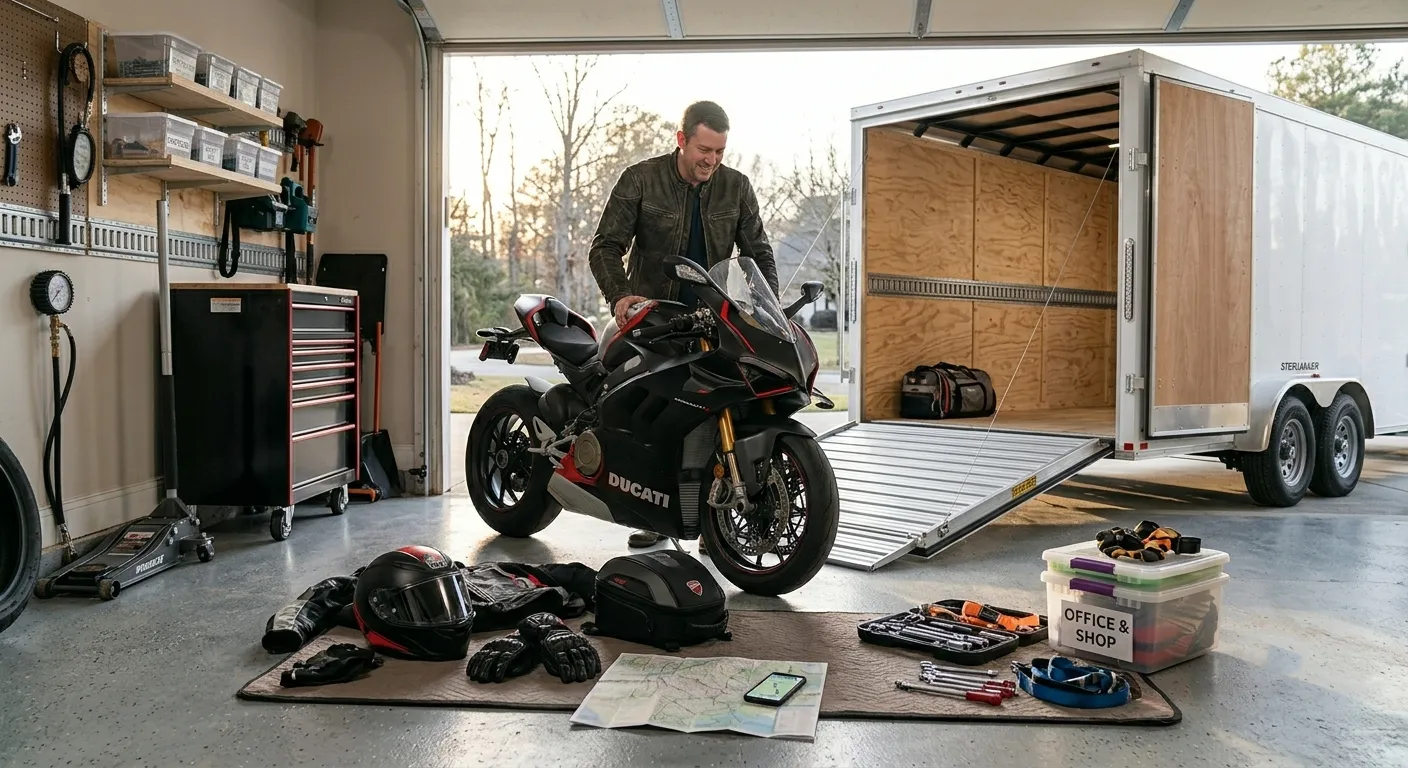
- Why Powersports Owners Choose Enclosed Trailers
- Start With the Vehicle You Plan to Haul
- What Size Enclosed Trailer Do You Need for a Motorcycle?
- What Size Trailer Do You Need for a UTV?
- What Size Trailer Do You Need for ATVs?
- Ramp Door vs Barn Doors for Powersports Hauling
- Why Tie-Down Placement Matters
- D-Rings vs E-Track: Which Is Better?
- Wheel Chocks for Motorcycle Hauling
- Floor Strength and Payload Capacity
- Single Axle vs Tandem Axle for Recreational Trailers
- Interior Height and Door Opening Clearance
- Trailer Width: Why Interior Width Matters
- Ventilation and Heat Control
- Interior Organization for Gear and Tools
- Loading Tips for Motorcycles, ATVs, and UTVs
- Weight Distribution Inside the Trailer
- Security Tips for Powersports Trailer Owners
- Maintenance Before Every Trip
- Best Enclosed Trailer Setup for Motorcycles
- Best Enclosed Trailer Setup for ATVs
- Best Enclosed Trailer Setup for UTVs
- Common Mistakes to Avoid
- Buyer Checklist Before Choosing an Enclosed Trailer
- How Make My Trailer Helps Recreational Buyers
- Frequently Asked Questions
- Final Thoughts
Why Powersports Owners Choose Enclosed Trailers
Open utility trailers are simple and affordable, but enclosed trailers offer several advantages for recreational hauling.
An enclosed trailer protects motorcycles, ATVs, UTVs, riding gear, tools, helmets, fuel cans, spare tires, coolers, and accessories from rain, road debris, sun exposure, and unwanted attention. When traveling long distances, a closed trailer keeps machines cleaner and helps prevent weather damage during highway travel. When parked overnight, an enclosed trailer also provides a more secure storage space than an open trailer.
For motorcycle owners, that protection matters even more when hauling cruisers, touring bikes, sport bikes, custom motorcycles, dirt bikes, or race bikes. A quality motorcycle can be damaged by road grime, loose gravel, rain, and exposure during travel. An enclosed trailer gives the bike a controlled space where it can be strapped down, protected, and stored with related gear.
For ATV and UTV owners, enclosed trailers are useful because many off-road trips involve more than one machine or more than just the vehicle itself. Riders often carry helmets, gloves, boots, riding clothes, fuel containers, recovery gear, spare belts, tools, air compressors, coolers, camping gear, hunting equipment, and cleaning supplies. A well-planned enclosed trailer keeps all of that organized in one place.
Start With the Vehicle You Plan to Haul
Before choosing a trailer size, measure the motorcycle, ATV, or UTV exactly as it will be loaded.
Do not rely only on the model name. A UTV with factory specs may not be the same size after adding a roof, windshield, mirrors, light bar, spare tire carrier, cargo box, larger tires, lift kit, doors, or aftermarket suspension. A motorcycle may also need more room than expected once you account for handlebars, saddlebags, fairings, mirrors, and tie-down angles.
Measure:
A common mistake is buying a trailer based only on the cargo area length. Interior width and interior height matter just as much, especially for UTVs and side-by-sides. A machine may technically fit inside the trailer but still be difficult to load, strap down, or exit after driving it in.
What Size Enclosed Trailer Do You Need for a Motorcycle?
For one motorcycle, many buyers look at smaller enclosed trailers such as 5x8, 6x10, or 6x12 models. The best choice depends on the bike type and how much extra gear you carry.
A small dirt bike or lightweight motorcycle may fit into a compact enclosed trailer, but larger cruisers, touring bikes, adventure motorcycles, and custom bikes often need more space. Saddlebags, fairings, wide handlebars, and long wheelbases can quickly make a small trailer feel tight.
For one motorcycle, a 6x10 or 6x12 enclosed trailer is often more practical than the smallest trailer size because it gives more room for the bike, wheel chock, tie-down angle, riding gear, and walking space. For two motorcycles, a 6x12, 7x14, or larger trailer may be needed depending on bike width and loading pattern. For multiple dirt bikes, race bikes, or mixed motorcycles, E-track and removable wheel chocks can make the interior more flexible.
A motorcycle trailer setup should usually include:

What Size Trailer Do You Need for a UTV?
UTVs and side-by-sides are where buyers need to be especially careful. Many modern UTVs are wider, taller, and longer than first-time buyers expect. Some sport models are narrow enough for certain trailers, while larger utility, crew cab, or long-wheelbase models may require a wider and longer enclosed trailer.
A 6-foot-wide trailer may work for some smaller side-by-sides, but many UTV owners should consider 7-foot-wide or 8.5-foot-wide enclosed trailers depending on the machine. Interior height is just as important. A UTV with a roof, light bar, lifted suspension, or oversized tires may need extra height.
For many UTV owners, common trailer sizes to consider include:
The right answer depends on the exact machine. Always compare the UTV’s true outside dimensions to the trailer’s interior width, rear door opening, interior height, and usable floor length.
What Size Trailer Do You Need for ATVs?
ATVs are usually easier to fit than UTVs because they are generally shorter and narrower, but buyers still need to plan carefully. One ATV may fit in a smaller enclosed trailer, while two ATVs may require a longer floor plan or a wider trailer depending on how they are positioned.
A 6x10 or 6x12 enclosed trailer may work well for one ATV plus gear. A 7x14 or larger trailer may be better for two ATVs, extra equipment, hunting gear, camping supplies, or a mixed setup with one ATV and one motorcycle.
ATV owners should think about:
Ramp Door vs Barn Doors for Powersports Hauling
For most motorcycle, ATV, and UTV owners, a rear ramp door is the most practical option. A ramp door allows machines to roll directly into the trailer without using separate portable ramps. This is especially useful for motorcycles, ATVs, side-by-sides, golf carts, and lawn equipment.
A ramp door is best when you plan to load:
Barn doors can still work well for general cargo, boxes, tools, and storage, but they are usually less convenient for powersports hauling unless separate ramps are used. Barn doors may be attractive for buyers who mainly use the trailer for cargo and only occasionally load small equipment. But if the main purpose is hauling motorcycles, ATVs, or UTVs, a ramp door is usually the smarter choice.
The ramp angle also matters. Low-clearance motorcycles, touring bikes, sport bikes, and some UTVs may need a longer or smoother ramp approach. If the ramp angle is too steep, the machine may scrape, bottom out, or feel unsafe during loading. Trailer height, beavertail design, ramp length, and ground conditions all affect loading comfort.

Why Tie-Down Placement Matters
Tie-down placement is one of the most important parts of a powersports trailer setup. Even if the trailer is the right size, poor tie-down placement can make the trailer difficult or unsafe to use.
A machine should be secured from multiple directions so it cannot roll forward, shift sideways, bounce loose, or move backward during transport. Straps should pull at stable angles, not straight down or awkwardly sideways. Anchor points should be strong enough for the load and located where straps will not rub against sharp edges, plastics, brake lines, suspension parts, or painted surfaces.
For motorcycles, a good setup often uses a front wheel chock and four tie-down points: two toward the front and two toward the rear. The front straps help stabilize the motorcycle and keep it pulled into the chock. The rear straps help prevent side-to-side movement and rear-end bounce.
For ATVs and UTVs, four-point tie-downs are commonly used, with straps connected near the front and rear of the machine. Some owners prefer axle straps, wheel nets, tire bonnets, or E-track wheel tie-down systems. The key is to use rated equipment, secure the machine from multiple points, and check the straps after driving a short distance.
D-Rings vs E-Track: Which Is Better?
D-rings and E-track both work, but they serve different purposes.
D-rings are fixed anchor points. They are strong, simple, and useful when you know exactly where your machine will sit every time. If you always haul one motorcycle in the same position, recessed floor D-rings can be a clean and effective solution.
E-track is more flexible. It allows tie-down locations to be adjusted depending on the load. This is helpful if the same trailer may carry one motorcycle one weekend, two dirt bikes the next weekend, an ATV another day, and general cargo after that. E-track can be installed on the floor or walls, depending on the cargo and interior layout.
For many powersports owners, the best setup combines both:
If you haul different machines or expect your setup to change, E-track is usually worth considering. If your use is simple and repetitive, D-rings may be enough.
Wheel Chocks for Motorcycle Hauling
A wheel chock is one of the most useful upgrades for motorcycle owners. It helps hold the front wheel upright and keeps the motorcycle positioned while straps are attached. Without a chock, loading and securing a motorcycle can be more difficult, especially for one person.
There are several types of wheel chocks:
If the trailer is used only for motorcycles, fixed chocks may be fine. If the trailer is used for mixed cargo, removable chocks or E-track-mounted chocks are more versatile. This allows the floor to stay open when hauling boxes, tools, furniture, or equipment.
For multiple motorcycles, staggered chock placement may help save space and keep handlebars from contacting each other. The trailer should also have enough width to leave walking room and enough tie-down points to secure each bike independently.

Floor Strength and Payload Capacity
Motorcycles, ATVs, and UTVs can vary dramatically in weight. A dirt bike may weigh only a few hundred pounds. A touring motorcycle may weigh 800 pounds or more. A large side-by-side can weigh well over 1,500 pounds before adding fuel, gear, accessories, and cargo.
That means buyers must look beyond trailer size. They also need to understand:
Payload capacity is especially important. Payload is not the same as GVWR. GVWR is the maximum total rated weight of the trailer plus cargo. Payload is the amount of cargo the trailer can carry after subtracting the trailer’s empty weight.
For example, a trailer with a higher GVWR may still have limited payload if it is heavily built or loaded with upgrades. Adding cabinets, insulation, A/C, water tanks, fuel, tools, spare tires, and gear can reduce available payload.
A strong floor is important for machines with concentrated weight at the tires. Plywood floor thickness, crossmember spacing, and ramp construction should match the load. UTVs and ATVs also create point loads as they roll up the ramp and sit on the floor. Buyers should confirm that both the trailer floor and ramp door are rated for the machine being hauled.
Single Axle vs Tandem Axle for Recreational Trailers
Single axle trailers are lighter, usually more affordable, easier to maneuver, and often enough for smaller motorcycles, dirt bikes, light ATVs, and compact setups. They are a good fit for buyers who want simple towing and do not need high payload capacity.
Tandem axle trailers are better for heavier loads, longer trailers, multiple machines, and more highway travel. A tandem axle setup can offer better stability, higher capacity, and improved braking options depending on the trailer configuration.
Choose a single axle if:
Choose a tandem axle if:
A 6x12 single axle may be perfect for a motorcycle owner or light-duty ATV user. A 7x14, 8.5x16, or larger tandem axle trailer may be better for UTV owners, multiple ATVs, or families hauling several machines.
Interior Height and Door Opening Clearance
Interior height is one of the most overlooked trailer setup details. Many buyers measure the vehicle height but forget about the rear door opening, ramp angle, roof accessories, mirrors, and the driver’s ability to enter or exit the machine inside the trailer.
For motorcycles and ATVs, standard interior height may be enough. For UTVs, extra height is often worth considering. A roof, light bar, roll cage, lifted suspension, or larger tires can create clearance issues.
Before ordering, confirm:
Extra height may slightly affect wind resistance and towing feel, but it can be essential for UTV owners.
Trailer Width: Why Interior Width Matters
Trailer width is not just about whether the machine fits. It also affects loading comfort, tie-down access, and usability.
A narrow trailer may technically fit a motorcycle or ATV, but leave little room to walk around it. A UTV may fit through the rear opening but leave no space to open doors or attach straps comfortably. This can make loading and unloading stressful.
A wider trailer gives more room for:
For UTVs, always compare the machine width to the trailer’s rear door opening and interior wall-to-wall width. Do not assume the listed trailer width equals usable interior width.
Ventilation and Heat Control
Ventilation matters more than many recreational buyers realize. Enclosed trailers can get hot, especially in Georgia, Florida, Alabama, South Carolina, North Carolina, Tennessee, Texas, and other warm-weather states. Heat can affect comfort, stored gear, fuel odor, moisture buildup, and the trailer interior.
Ventilation options include:
For motorcycle and powersports owners, ventilation helps when storing damp riding gear, muddy equipment, fuel containers, or machines that were recently used. It also helps reduce stale air and moisture when the trailer is parked.
If you plan to use the trailer as a mobile garage, dressing space, race trailer, or weekend base camp, ventilation becomes even more important.

Interior Organization for Gear and Tools
A powersports trailer often carries far more than the vehicle itself. Riders need a place for helmets, boots, gloves, goggles, jackets, tools, tie-down straps, chargers, oil, spare parts, cleaning supplies, and coolers.
Useful organization upgrades include:
The goal is to keep heavy items low, sharp items secured, and frequently used items easy to reach. Avoid loose cargo on the floor. Loose helmets, tools, fuel cans, jacks, or coolers can slide into the machine during travel.
Loading Tips for Motorcycles, ATVs, and UTVs
Loading should be slow, controlled, and repeatable. Do not rush the process. Many trailer accidents happen during loading and unloading, not on the road.
Before loading:
For motorcycles, walk the bike up carefully or ride it only if you are experienced and the ramp setup is safe. A wheel chock can help position the bike. For ATVs and UTVs, load slowly and avoid sudden throttle movements. Make sure the machine is centered and positioned for proper weight balance.
After loading, secure the machine, then shake it or push against it to confirm it does not move. Recheck straps after the first few miles.
Weight Distribution Inside the Trailer
Loading position affects towing stability. Too much weight behind the axle can contribute to sway. Too much tongue weight can overload the tow vehicle’s rear suspension and reduce steering control. The goal is balanced, stable loading that stays within the trailer’s rating and the tow vehicle’s rating.
Place heavy items low and secure them. Keep the main machine centered side-to-side. Avoid stacking heavy gear high on shelves. Keep fuel containers secure and ventilated. If carrying multiple machines, plan the loading order and strap angles before the trip.
Always check:
A trailer is only as safe as the full towing system.
Security Tips for Powersports Trailer Owners
Motorcycles, ATVs, and UTVs are valuable. An enclosed trailer helps hide and protect them, but buyers should still think about security.
Consider:
For business owners or serious recreational users, documentation is important. Keep photos of the trailer, VIN, machines, upgrades, and gear. If theft or damage occurs, documentation can help with insurance claims.
Maintenance Before Every Trip
Before every trip, inspect the trailer and towing setup. A simple pre-trip routine can prevent breakdowns and dangerous road issues.
Check:
Also check the motorcycle, ATV, or UTV. Make sure it is not leaking fluids and that loose accessories are secured. Remove or secure anything that could move during transit.
Best Enclosed Trailer Setup for Motorcycles
A strong motorcycle trailer setup should include:
For one large bike, a 6x12 is often more comfortable than a smaller trailer because it allows better strap angles and room for gear. For two bikes, a 7x14 or larger trailer may be more practical. For three or more motorcycles, layout planning becomes critical.
Best Enclosed Trailer Setup for ATVs
A strong ATV trailer setup should include:
For one ATV, a 6x10 or 6x12 may work depending on the ATV and storage needs. For two ATVs, a 7x14 or larger trailer may be better. If carrying hunting gear, camping gear, coolers, or fuel, add more space than the ATV alone requires.
Best Enclosed Trailer Setup for UTVs
A strong UTV trailer setup should include:
For UTV owners, the biggest mistakes are underestimating height, width, loaded weight, and accessory space. Always measure the machine fully equipped, not just the base model specification.
Common Mistakes to Avoid
Buyer Checklist Before Choosing an Enclosed Trailer
Before ordering or buying, answer these questions:
How Make My Trailer Helps Recreational Buyers
Make My Trailer helps buyers compare enclosed trailer options based on real-world use, not just trailer size. For motorcycle, ATV, and UTV owners, that means looking at loading style, machine dimensions, ramp door needs, floor strength, axle setup, tie-down layout, interior height, trailer width, ventilation, and storage.
A recreational trailer should make trips easier. It should protect the equipment, simplify loading, keep gear organized, and give the owner confidence on the road. Whether the trailer is used for weekend rides, motorsports events, trail parks, hunting trips, farm use, or family recreation, the setup should match the way the owner actually uses it.
The best enclosed trailer is not always the biggest trailer. It is the trailer that fits the machine, matches the tow vehicle, supports the load, gives enough clearance, and includes the right setup features from the beginning.
Frequently Asked Questions
What is the best enclosed trailer for motorcycles?
The best enclosed trailer for motorcycles usually includes a ramp door, wheel chock, four tie-down points per bike, D-rings or E-track, interior lighting, ventilation, and enough room to walk around the bike. A 6x10 or 6x12 can work well for one motorcycle, while two or more motorcycles may need a 7x14 or larger trailer depending on bike size.
What size trailer do I need for a UTV?
The right trailer size depends on the UTV’s actual width, height, length, and weight. Many UTV owners should consider a 7-foot-wide or 8.5-foot-wide enclosed trailer, especially if the machine has a roof, mirrors, light bar, lift kit, or larger tires. Always measure the UTV with all accessories installed.
Can a 6x12 enclosed trailer haul a motorcycle?
Yes, a 6x12 enclosed trailer can often be an excellent size for one motorcycle and gear. It usually provides more practical room than smaller trailers and allows better tie-down angles, storage space, and easier loading.
Can a 6x12 enclosed trailer haul a UTV?
Sometimes, but not always. Many UTVs are too wide or too tall for certain 6-foot-wide enclosed trailers. Measure the UTV’s full width, height, and length, then compare those numbers to the trailer’s interior dimensions and rear door opening.
Is E-track better than D-rings?
E-track is more flexible because strap positions can be adjusted. D-rings are simple and strong for fixed tie-down locations. Many powersports owners benefit from using both.
Do I need wheel chocks for motorcycles?
A wheel chock is strongly recommended for motorcycle hauling because it helps keep the front wheel positioned and the bike upright while straps are secured. Removable chocks are useful if the trailer is also used for general cargo.
Should I choose single axle or tandem axle?
Choose a single axle for lighter loads, easier maneuvering, and lower cost. Choose a tandem axle for heavier machines, multiple vehicles, longer trailers, better stability, and higher payload needs.
Do enclosed trailers need ventilation?
Ventilation is highly recommended, especially in warm climates or when carrying fuel, damp riding gear, muddy equipment, or machines after use. Roof vents, side vents, and insulation can improve comfort and reduce heat buildup.
What should I check before towing?
Check tire pressure, lug nuts, lights, brakes, coupler, safety chains, breakaway cable, ramp door, side door, tie-downs, floor condition, and machine security. Also confirm that the trailer, hitch, and tow vehicle are rated for the loaded weight.
Final Thoughts
A motorcycle, ATV, or UTV is a major investment, and the trailer that carries it should be planned with the same level of care. The right enclosed trailer setup protects the machine, improves security, simplifies loading, and keeps gear organized. The right size, ramp door, tie-down system, floor strength, ventilation, and interior layout can make the difference between a frustrating trailer and one that becomes part of every great trip.
For recreational buyers, the best approach is simple: measure first, plan the layout, confirm weight ratings, choose the right loading system, and build the trailer around the way it will actually be used.
Ready to build the ultimate powersports trailer?
Explore Custom Setups at Make My Trailer