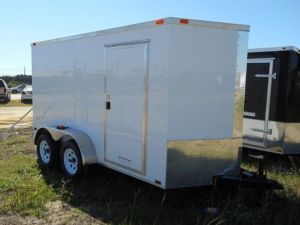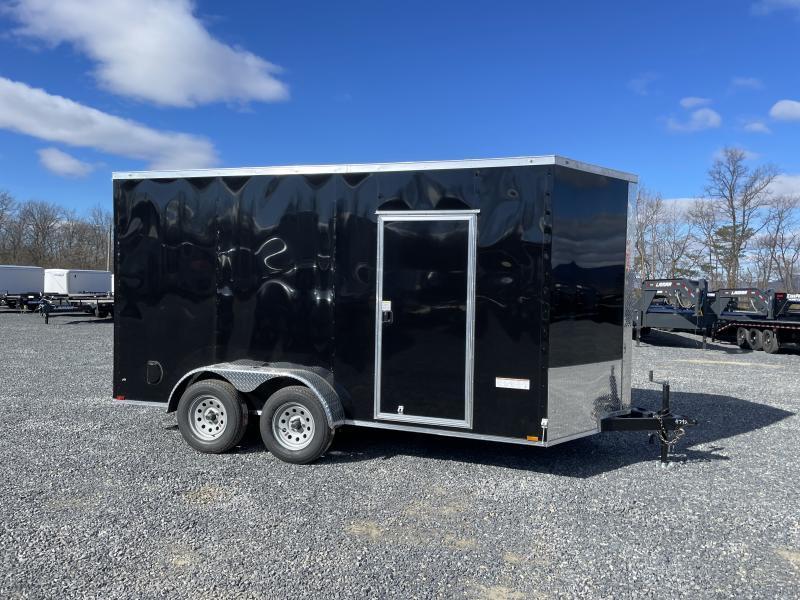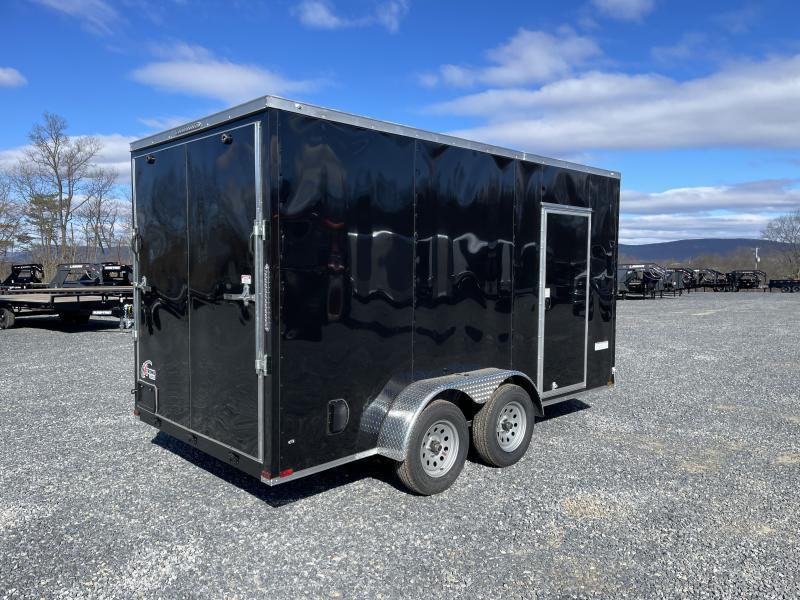



Overall Length: 17’6″ / 210 in (Breakdown: 14′ on the Box + 3’6″ on the Tongue) 20″ on the Vnose
Overall Width: 7’6″ / 90 in (Breakdown: 6′ on the Box + 9″ on each Fender)
Overall Height: 7’7″ / 91 in (Breakdown: 6’3″ on the Box + 16″ from the ground to the box)
Overall Height (Diamond): 7’10” / 94 in (Breakdown: 6’6″ on the Box + 16″from the ground to the box)
Overall Length: 13’9″ Box (Breakdown: Subtract 3″ which counts for rear door & framing) plus 20″ on the Vnose
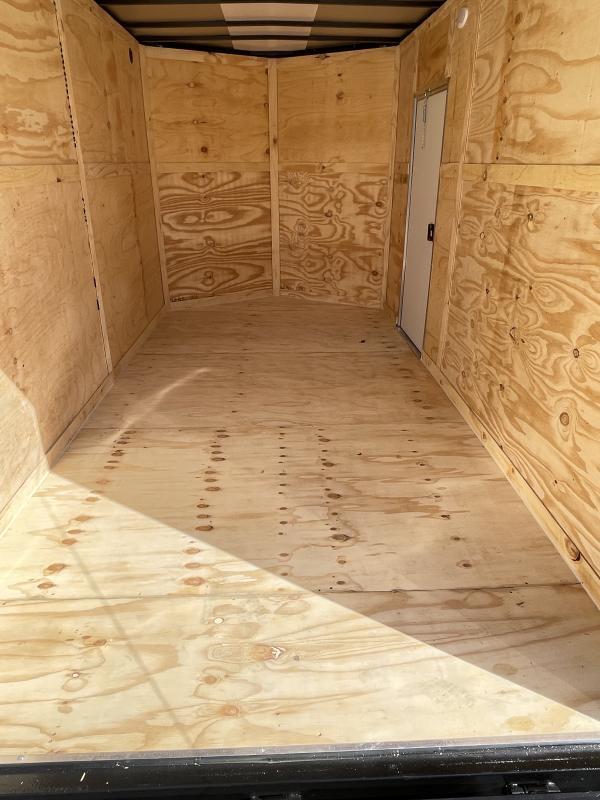
Overall Width: 5’8″ (Breakdown: Subtract 4″ (2″ on each side) which counts for plywood & framing)
Overall Height: 6’3″
Overall Height (Diamond): 6’6″
Width: 62″ (Breakdown: Subtract 10″ (5 on each side) which counts for plywood & framing)
Height: 69″ (Breakdown: Subtract 6″ which counts for plywood & framing)
Height (Diamond): 72″ (Breakdown: Subtract 6″ which counts for plywood & framing)
7-way Round plug
5x4.5 (5 Lug)
6 Ply
Screws are 4′ apart instead of being every 2′
It’s an asphalt undercoating paint
We developed a section exclusively for Custom Options where we show sample photos and explain most popular options:
Click Here for More Information.
Here are examples of some of the most popular Custom Options:
– Blackout Package
– Electrical Package
– Insulation Package
– Rubber Flooring
– Etracks
– D-rings
– Windows
– Extended Tongue
– Extra Height
– Ladder Racks
– Finished Interior (Metal/Vinyl)
– Air Conditioner
– Lighting Options
– Axle Upgrades
– Concession Window
– Special Door Options
– Cabinets
– Barn Doors

Introduction: Why a 6x14 Double Axle Cargo Trailer is Your Smart Choice
Finding the right enclosed cargo trailer is an investment in efficiency, security, and capability. For businesses and individuals needing a versatile hauling solution, the 6x14 double axle configuration strikes an ideal balance between manageable size and serious capacity. It’s a popular choice for contractors, landscapers, motorsports enthusiasts, and anyone needing to transport goods securely. However, not all trailers are created equal. The difference between a reliable workhorse and a constant source of frustration lies in the details of its construction and components. This guide is designed to demystify those details and empower you to make an informed decision.
The Versatility of a 6x14 Enclosed Cargo Trailer
The 6x14 footprint is the sweet spot for many applications. It’s large enough to haul significant loads, from construction materials and landscaping equipment to ATVs and moving boxes, yet it remains nimble enough to navigate city streets and tighter job sites. The enclosed design of these cargo trailers provides critical protection from weather, theft, and road debris, transforming it from a simple hauler into a secure, mobile storage unit. This versatility makes it one of the most sought-after sizes on the market.
Why “Double Axle” is Non-Negotiable for Quality and Capacity
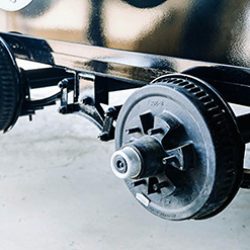
When you see “double axle” (or tandem axle), it signifies a major step up in performance. A single axle trailer is limited in its weight capacity and can be less stable under heavy loads or at high speeds. The addition of a second axle distributes the weight more evenly, dramatically increasing the Gross Vehicle Weight Rating (GVWR) and payload capacity. This feature is fundamental for anyone serious about hauling heavy equipment or large volumes of material safely and legally.
What This Buyer’s Guide Will Cover
This guide will walk you through every critical aspect of selecting a top-tier 6x14 double axle trailer. We will dissect the advantages of the double axle system, decode key specifications like frame construction and interior height, examine essential components from walls and floors to doors and couplers, and explore valuable customization options. By the end, you’ll have the knowledge to evaluate quality, understand the sales process, and confidently choose the perfect trailer for your needs.
The Double Axle Advantage: Power, Stability, and Longevity
The decision to opt for a double axle design is the first step toward purchasing a truly capable cargo trailer. This configuration offers distinct, tangible benefits that directly impact safety, performance, and the trailer’s lifespan.
Increased Payload Capacity: Haul More, Worry Less
The primary benefit of a second axle is a substantial increase in payload capacity. A typical 6x14 single axle trailer might have a GVWR of 2,990 lbs, leaving you with a payload of only 1,500-2,000 lbs after the trailer’s own weight. In contrast, a double axle model, commonly equipped with two 3,500 lb axles, boasts a 7,000 lb GVWR. This allows for a payload of approximately 5,000 lbs, enabling you to haul heavier machinery, denser materials, and larger volumes without exceeding legal and safety limits.
Enhanced Stability and Control
Four tires on the ground provide significantly more stability than two. This is especially noticeable on highways, in crosswinds, and on uneven terrain. A double axle trailer tracks more smoothly behind your tow vehicle, reducing sway and improving overall handling. This enhanced control not only makes the towing experience less stressful but also inherently safer, reducing the risk of accidents caused by instability.
Improved Durability and Tire Longevity
Distributing the load across four tires instead of two reduces the stress on each individual tire and the suspension components. This leads to more even tire wear and a longer lifespan for your tires. Furthermore, the dual axle setup provides a crucial layer of redundancy. In the event of a single tire blowout, the remaining tire on that side can support the load temporarily, giving you a much better chance of pulling over safely to make a repair.
Braking Performance: The Importance of Electric Brakes
Most double axle trailers come standard with electric brakes on at least one axle, and often both. This is a critical safety feature. Unlike surge brakes, electric brakes are synchronized with your tow vehicle’s braking system, providing smoother, more controlled stopping power. When hauling heavy loads, this superior braking performance can drastically reduce stopping distances and prevent dangerous situations like jackknifing.
Decoding Key Specifications: What to Look for in Your 6x14
Beyond the axle configuration, the quality of a trailer is defined by its core specifications. Understanding these numbers and materials is essential to comparing different models and making a smart investment.
Overall Dimensions and Interior Height
While the “6x14″ designation refers to the approximate interior box dimensions, always verify the exact measurements. Pay close attention to the interior height. A standard height is often around 6’3″ (75 inches), which is adequate for many tasks. However, if you need to load taller items like a UTV or simply want to walk inside without crouching, opting for extra height (e.g., 6’6” or 7′) is a worthwhile upgrade that significantly improves usability.
Frame and Construction Materials: Building a Foundation of Strength
The trailer’s frame is its skeleton, and its strength is paramount. Look for trailers constructed with a main frame made from rectangular Steel Tube. This design is significantly stronger and more resistant to twisting and flexing than weaker alternatives like C-channel or Z-post construction. Main frame tubes of 2″x4″ or larger indicate a robust build. Similarly, wall studs and roof bows should also be made from Steel Tube for maximum structural integrity.
Axle Types and Capacity
The most common setup for a 6x14 is two 3,500 lb axles. A leaf Spring Axle is the industry standard, known for its durability and cost-effectiveness. Torsion axles are an available upgrade, offering a smoother, quieter ride with independent suspension for each wheel. Regardless of type, ensure the Gross Axle Weight Rating (GAWR) for each axle is clearly stated and that the combined rating provides the GVWR you require for your cargo.
Wheels and Tires: Your Trailer’s Connection to the Road
The wheels and tires should be rated to handle the trailer’s GVWR. Look for high-quality radial tires, which run cooler and last longer than bias-ply tires. The bolt pattern should be a common size (e.g., 5 on 4.5) to make finding replacements easier. Quality trailers will feature sturdy steel wheels, with Aluminum wheels often available as a cosmetic and lightweight upgrade.
Essential Components and Features: What Comes Standard and What to Consider
The details and components of an enclosed cargo trailer determine its everyday functionality and durability. Here’s a breakdown of what to inspect.
Walls and Flooring: Interior Durability
The interior surfaces must withstand abuse. The industry standard for quality trailers is a ¾” Plywood Floor and ⅜” Plywood Walls. Plywood is strong, durable, and makes it easy to mount E-tracks, shelving, or other fixtures. Cheaper alternatives like OSB (Oriented Strand Board) are less resistant to moisture and impact. Also, check the spacing of the floor crossmembers and wall studs; a 16” on-center spacing provides far greater strength and support than a 24” spacing.
Doors and Access: Functionality for Loading and Unloading
A rear Ramp door is the most popular and versatile option, typically featuring a spring assist mechanism to make it easy to lift and lower. An extension flap is a valuable addition to ease the transition for wheeled equipment. A Side Door, usually 32” or 36” wide, provides convenient access to the front of the trailer without having to lower the main ramp. Look for RV-style flush locks on the side door for better security and a cleaner look.
Roof and Exterior Protection
The exterior skin is your first line of defense against the elements. Most trailers use bonded Aluminum panels. Check the thickness of the aluminum; .024” is standard, while thicker .030” or .080” Polycore options offer increased durability and resistance to dents. The roof should be a single piece of Galvalume or aluminum to minimize the chance of leaks. At the front, a 24” stone guard is essential to protect the trailer from rock chips and road debris.
Electrical System and Lighting
Modern trailers should feature a full LED lighting package for tail lights, brake lights, and clearance markers. LEDs are brighter, more durable, and consume less power than traditional incandescent bulbs. Inside, at least one 12V dome light should be standard. The wiring should be protected and neatly routed, and the trailer connector should be a standard 7-way RV plug to control lights and electric brakes.
Coupler and Tongue Jack
The coupler connects the trailer to your tow vehicle and should be a standard 2-5/16” ball coupler for a double axle trailer. The Tongue Jack is used to raise and lower the front of the trailer for hitching. A 2,000 lb top-wind or side-wind Tongue Jack is typical, and a sand foot is a useful feature to prevent it from sinking into soft ground.
Customization and Optional Upgrades: Tailoring Your Trailer to Your Needs
A key advantage of buying a new cargo trailer is the ability to customize it with options that perfectly suit your intended use.
Interior Customization for Specific Applications
The interior is a blank canvas. Consider adding E-track or D-rings to the floors and walls for versatile cargo securement points. For contractors, ladder racks and built-in shelving can create a mobile workshop. If you’re converting the trailer for camping or concessions, adding insulation, finished walls, and electrical packages are common options.
Exterior Aesthetics and Practical Upgrades
Beyond standard white or black, many manufacturers offer a range of colors for the aluminum skin. Upgrading to thicker aluminum or a two-tone design can enhance both durability and appearance. Other practical exterior upgrades include stabilizer jacks for leveling the trailer when unhitched, aluminum wheels for a sharper look, and upgraded fenders.
Application-Specific Considerations
Think about your primary use. A landscaper might want a side ramp for mowers. A car hauler will need a beavertail (a sloped rear floor) for better loading clearance and heavy-duty D-rings. A mobile business might require a concession window and specific electrical hookups. Discussing your needs during the sales process ensures you get the right options from the start.
Evaluating Quality and Durability: What to Look for Before You Buy
Assessing the overall build quality is crucial for ensuring your trailer provides years of reliable service.
Manufacturer Reputation and Craftsmanship
Research the manufacturer’s reputation. Look for brands known for using quality materials and demonstrating solid craftsmanship. A reputable builder will stand behind their product. Look for clean welds, proper sealing around seams and edges, and wiring that is protected and properly secured, not just loosely hanging under the frame.
Detailed Inspection Checklist
When inspecting a trailer in person or asking for details from a sales representative, check these points:
- Frame: Confirm it’s a Steel Tube main frame, not C-channel.
- Spacing: Verify 16″ on-center spacing for floor, walls, and ceiling supports.
- Interior: Ensure it has ¾” Plywood Floor and ⅜” Plywood Walls.
- Seals: Check all seals around doors, vents, and seams to ensure they are weatherproof.
- Welds: Look for consistent, clean welds on the frame and tongue.
Understanding the Manufacturer’s Limited Warranty
A good warranty is a sign of a manufacturer’s confidence in their product. Most quality trailers come with a limited structural warranty of three to five years. Read the fine print to understand what is covered—typically the frame and structure—and what is excluded, such as tires, axles (often covered by their own manufacturer), and cosmetic issues.
The Smart Buyer’s Journey: From Research to Ownership
The final step involves navigating the purchase process. Research dealers in your location and compare their inventory and pricing. Don’t be afraid to ask detailed questions based on the knowledge you’ve gained. When you’re ready, request a detailed quote that lists all standard features and any added options to ensure there are no surprises. A transparent sales process is a hallmark of a trustworthy dealer.

Conclusion
Choosing the perfect 6x14 double axle quality cargo trailer is a process of matching your specific needs with high-quality construction standards. By focusing on a robust Steel Tube frame, a reliable double Spring Axle system, and durable interior surfaces like a Plywood Floor and Plywood Walls, you build a foundation for a long-lasting, reliable investment. Pay attention to the details—from the interior height and door configurations to the quality of the welds and wiring. Use this guide as your checklist, ask pointed questions, and inspect any potential trailer thoroughly. By doing so, you will move beyond a simple purchase and make a strategic investment that will serve you reliably for countless hauls to come.